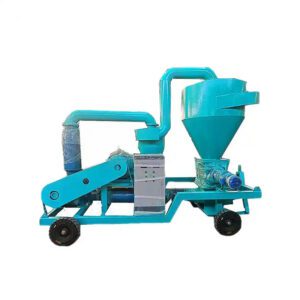
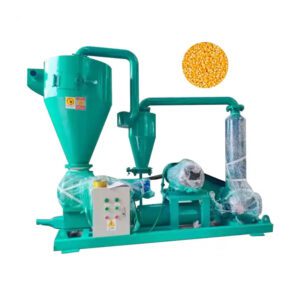
Vacuum Powder Conveyor Solution Air Driven Lifter System
Vacuum powder conveyor is a sealed pneumatic material handling system that uses negative pressure airflow to transport powders, granules, and pellets efficiently. It ensures dust-free, safe, and automated conveying over long distances or complex layouts. The system integrates vacuum suction, cyclone separation, and automatic discharge functions, making it ideal for continuous industrial production lines requiring high efficiency, hygiene, and minimal material loss.
Compare
Vacuum Powder Conveyor Product Introduction
Vacuum powder conveyor system is an advanced pneumatic conveying solution designed for efficient bulk material transfer. It uses vacuum negative pressure to suck materials from feed ports into a sealed pipeline system.
Inside the filter chamber, air and materials are separated, allowing powder and granules to fall into the silo by gravity. Fine particles are captured by cyclone and filter systems to ensure clean operation.
When the silo is full, the system automatically stops the vacuum pump, balances pressure, and starts discharge. Materials are released into storage containers, while the filter is cleaned using back-flushed air.
This system is widely used in food, chemical, pharmaceutical, and industrial powder handling applications.
Working principle
Step 1: Vacuum Generation
The vacuum pump generates negative pressure inside the sealed pipeline system.
Step 2: Material Suction
Bulk materials are sucked into the pipeline through the feed port using airflow.
Step 3: Pneumatic Transport
Materials are transported through enclosed pipelines under vacuum airflow.
Step 4: Separation Process
In the filter chamber, air and materials are separated using cyclone and filter elements.
Step 5: Material Collection
Separated materials fall into the silo automatically due to gravity.
Step 6: Pressure Balance
When the silo is full, the vacuum pump stops and system pressure stabilizes.
Step 7: Discharge Process
The discharge valve opens, and materials are released into storage containers.
Step 8: Filter Cleaning
Back-flushed air cleans the filter element automatically for next cycle.
Product Parameter Table
| Parameter | Specification |
| Specification | Φ800 × 2000 mm |
| Conveying Capacity | ≤3000 kg/h |
| Power | 11 kW |
| Filter Area | 4.6 m² |
| Material | 304/316L |
Decision Table
| Feature | Vacuum Powder Conveyor | Screw Conveyor | Belt Conveyor |
|---|---|---|---|
| Material Type | Powder, granules, pellets | Powder, granular | Bulk solids |
| System Type | Fully enclosed vacuum system | Mechanical screw system | Open mechanical system |
| Dust Control | Excellent (sealed system) | Medium | Low |
| Material Damage | Very low | Medium | Medium |
| Flexibility | Very high (pipeline routing) | Low | Medium |
| Automation | High (PLC integration) | Medium | Medium |
| Cleaning | Automatic filter cleaning | Manual cleaning | Medium |
| Application Range | Food, pharma, chemical, industrial | Industrial bulk handling | Logistics, mining |
Main Features
- Negative pressure conveying ensures stable and controlled powder transfer without leakage
- Integrated cyclone separation improves fine particle recovery and system efficiency
- Automatic filter back-flushing keeps continuous operation with minimal manual cleaning
- Buffer-based feeding design stabilizes material flow during variable production loads
- Optional vibration assistance improves discharge performance for sticky or cohesive powders
- Fully sealed stainless steel pipeline prevents contamination and environmental dust exposure
- Modular system structure allows easy adaptation to different plant layouts and distances
- Smart pressure balance control enables automatic start-stop cycle operation
- Compatible with rotary valve feeding for uninterrupted continuous conveying process
Why Choose This System
- Fully automated material handling with minimal labor
- Dust-free enclosed system improves workplace safety
- Suitable for long-distance and complex pipeline layouts
- Reduces material waste and contamination risk
- Handles powders, granules, and pellet materials efficiently
- Supports continuous industrial production cycles
- Optional vibration system for difficult materials
- High reliability with stainless steel industrial design
Application Scenarios
- Bulk powder unloading from trucks, railcars, and silo storage systems in industrial plants
- Food ingredient processing lines including flour, sugar, starch, cocoa, and milk powder
- Pharmaceutical production environments requiring hygienic and contamination-free powder transfer
- Chemical manufacturing facilities handling pigments, additives, resin powders, and fine chemicals
- Plastic processing plants conveying resin pellets and polymer powder materials
- Cement and construction material plants transporting fly ash, lime, and fine cement powders
- Agricultural processing systems for grain, feed, fertilizer, and seed handling operations
- Automated production lines requiring closed-loop material feeding and batching systems
- Multi-floor factory conveying systems where flexible pipeline routing is required
- Dust-sensitive environments where emission control and workplace safety are critical
Buying Guide
When selecting a vacuum powder conveyor system, consider:
- Material characteristics (powder, granule, sticky, fragile)
- Required conveying capacity (kg/h or t/h)
- Conveying distance and vertical height
- Continuous or batch operation requirement
- Stainless steel grade (304 or 316L)
- Need for vibration or anti-blocking system
- Automation level and PLC integration
- Industry hygiene standards (food or pharmaceutical grade)
FAQ
Q1: What is a vacuum powder conveyor system used for?
A: It is used for dust-free transport of powders, granules, and pellets in industrial production systems.
Q2: How does a vacuum pneumatic conveyor work?
A: It uses negative pressure airflow to suck materials into pipelines and separate them at the discharge point.
Q3: Can vacuum conveyor handle fine powder materials?
A: Yes, it is designed for fine powders, preventing dust leakage and material loss.
Q4: What industries use vacuum powder conveying systems?
A: Food, chemical, pharmaceutical, agricultural, and plastic industries widely use it.
Q5: What is the advantage of cyclone separation system?
A: It improves efficiency by separating fine powder from airflow before filtration.
Q6: Can vacuum conveyor handle sticky materials?
A: Yes, optional vibration systems help discharge viscous or sticky materials.
Q7: Is vacuum conveying system fully automated?
A: Yes, it supports automatic suction, discharge, and filter cleaning cycles.
Q8: What is the benefit of enclosed conveying system?
A: It prevents dust leakage, improves safety, and ensures clean production environments.
Conclusion
The vacuum powder conveyor system is a highly efficient, automated, and dust-free material handling solution designed for modern industrial production. With its negative pressure conveying technology, cyclone separation, and automatic cleaning system, it ensures stable performance, low maintenance, and high productivity.
It is widely used across food, chemical, pharmaceutical, and industrial sectors, making it an ideal solution for safe and efficient bulk material transfer.
Contact us to get your quotation now.
Get in touch with our engineering team.
Related products
-
Pneumatic Conveying Equipment/Pneumatic Conveyor
10T 50T Corn Suction Machine, Pneumatic Vacuum Particle Feeder, Conveyor, Best-Selling Wheat Or Sawdust Particle Suction Machine
 Pneumatic Conveying Equipment/Pneumatic Conveyor
10T 50T Corn Suction Machine, Pneumatic Vacuum Particle Feeder, Conveyor, Best-Selling Wheat Or Sawdust Particle Suction Machine
Pneumatic vacuum conveyor, also called suction grain machine. It is the 1 kind of advanced material handling machinery, that can handle and unload grain and other bulk particles, such as wheat, rice, peanuts, soybeans, corn, rapeseed, cottonseed, feed, etc., and can also be used for non-food bulk particles, such as Plastic particles, etc.
SKU: n/a -
Pneumatic Conveying Equipment/Pneumatic Conveyor
Farm Conveying Equipment Vacuum Corn Rice Soybean Unloading Truck Loading Conveyor Pneumatic Dust Conveyor
Pneumatic Conveying Equipment/Pneumatic ConveyorFarm Conveying Equipment Vacuum Corn Rice Soybean Unloading Truck Loading Conveyor Pneumatic Dust Conveyor
A pneumatic conveyor ( grain suction machine) is an advanced material handling machinery, that can convey in all directions such as horizontally, inclined, and vertically, It can transport granular/particle materials such as rice, rice, wheat, corn, sorghum, peanuts, soybeans, plastic pellet, resin, barley, chips, and other granular..When conveying grains, it has the effect of removing impurities and dehydrating grains.
SKU: n/a -
Pneumatic Conveying Equipment/Pneumatic Conveyor
Pneumatic Conveying System Automatic Feeding Transport System Screw Conveyor For Powder And Pellet
Pneumatic Conveying Equipment/Pneumatic ConveyorPneumatic Conveying System Automatic Feeding Transport System Screw Conveyor For Powder And Pellet
High efficiency grain suction machine features:
1. The equipment has the characteristics of convenient, fast, labor-saving and people-saving.
2. less dust pollution, flexible and convenient operation.
3. Just arrange the conveying pipeline according to the needs, and you can carry out horizontal, vertical, and inclined conveying.
4. High air pressure, long conveying distance, high lift, small size, low noise and low energy consumption.
5. Use a special suction nozzle for local deep suction. It can go deep into the grain layer and obtain materials below 6 meters.SKU: n/a