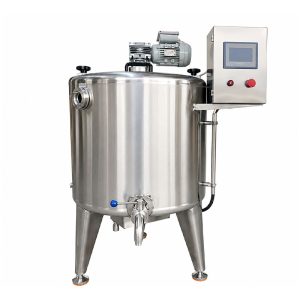
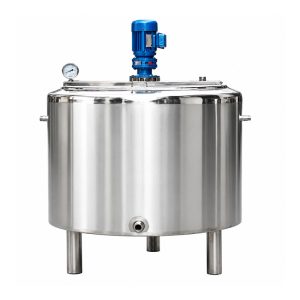
Ripening Heating/Cooling Mixing Tank with Ice Cream Homogeneous Function
The Heating/Cooling Tank is a professional piece of equipment designed for large-scale yogurt production, capable of processing fresh liquid milk or milk powder into flavored milk yogurt. It integrates three key processing functions—heating, pasteurizing, and cooling—with an automatic operation feature, significantly streamlining the yogurt-making workflow and reducing manual intervention.
Compare
Parameter Table:Heating/Cooling Mixing Tank
|
Parameter Category
|
Specific Information
|
|
Product Name
|
Industrial Yogurt Maker Machine
|
|
Core Components
|
PLC, Engine, Bearing, Gearbox, Motor, Pressure Vessel, Gear, Pump
|
|
Key Selling Points
|
Low Noise Level, Automatic Operation
|
|
Power (W)
|
3.5 KW
|
|
Voltage
|
220V / 380V
|
|
Weight
|
300 KG
|
|
Dimension (L×W×H)
|
2200×1350×1150 mm
|
|
Capacity
|
300L ~ 10000L (Commercial Yogurt Maker Machine)
|
|
Raw Material
|
Fresh Liquid Milk, Milk Powder
|
|
Final Product
|
Flavoured Milk Yogurt
|
|
Application
|
All Kinds of Yoghurt Making, Yogurt Production Line
|
|
Processing Types
|
Heating + Pasteurizing + Cooling
|
|
Tank Type
|
Cooling Tank, Heating Tank, Sterilization Tank, Fermentation Tank
|
|
Refrigeration Medium
|
R22
|
|
Inspection & Reports
|
Machinery Test Report (Provided); Video Outgoing-Inspection (Provided)
|


Application:
- Medium-to-Large-Scale Yogurt Production Factories
- Dairy Product Processing Lines
- Commercial Yogurt Brand OEM/ODM Facilities
- Regional Specialty Yogurt Workshops
- Food & Beverage Enterprises Expanding Yogurt Business


Contact us to get your quotation now.
Related products
-
Cream Cooling & Heating Systems
1000L Sanitary Ice Cream Aging Tank with Cooling System
Designed for commercial ice cream production, this 1000L sanitary aging tank combines controlled cooling, gentle agitation, and insulated stainless steel construction in one hygienic processing vessel. A honeycomb-style jacket circulates cooling medium around the inner tank to rapidly reduce and maintain mix temperature, while the agitator supports uniform maturation. With a sloped bottom, easy-clean surfaces, adjustable temperature control, and robust three-layer construction, the tank provides efficient batch handling before freezing and downstream ice cream processing.
SKU: n/a -
Cream Cooling & Heating Systems
Automatic 3 in 1 Pasteurizer and Homogenizer 90℃ Heating -3℃ Cooling Equipment for Italian Hard Ice Cream Shops
 Cream Cooling & Heating Systems
Automatic 3 in 1 Pasteurizer and Homogenizer 90℃ Heating -3℃ Cooling Equipment for Italian Hard Ice Cream Shops
Pasteurizer and Homogenizer Highlight:
Pasteurizer and Homogenizer Core Highlights
This equipment integrates practicality, safety, and efficiency, and its core highlights are highly aligned with the needs of small-to-medium production scenarios and healthy food processing, specifically reflected in the following aspects:1. Dual-Core Function Integration, One Machine for Multiple Needs
It combines pasteurization and homogenization into one, eliminating the need for separate purchase and connection of two sets of equipment. For example, in dairy processing, it can complete bacteria killing and fat globule crushing in a single process; in beverage production, it can simultaneously extend the shelf life of juices and optimize their taste. This not only saves the initial equipment investment cost but also reduces the occupied space of the production line (suitable for small workshops or catering backends with limited space) and simplifies the operation process, avoiding the quality loss caused by material transfer between different equipment.2. Food-Grade Material + Precise Temperature Control, Double Guarantee for Safety
- Material Safety: The contact part with food is made of stainless steel, which is corrosion-resistant, easy to clean, and does not release harmful substances even under long-term high-temperature operation. It meets food processing hygiene standards, avoiding the problem of secondary pollution of materials (such as milk, fruit juice) caused by unqualified materials.
- Precise Temperature Control: With 90℃ accurate heating control, it can stably maintain the pasteurization temperature—neither too low to kill harmful bacteria (such as Brucella in raw milk) nor too high to destroy nutrients (such as lactoferrin in milk, vitamins in fruit juice). Compared with traditional manual heating (prone to temperature fluctuations), it ensures the consistency of product safety and nutrition in each batch.
3. Automatic Operation, Reducing Threshold and Improving Efficiency
Adopting an automatic operating system, after setting the parameters (such as pasteurization time, homogenization speed), the equipment can complete the entire process independently without manual monitoring. This has two core advantages: on the one hand, it lowers the operation threshold—even staff without professional technical background can use it proficiently, reducing the training cost of enterprises; on the other hand, it avoids human errors (such as forgetting to turn off the heat, uneven homogenization) and improves the production efficiency. For example, in hotel breakfast preparation, it can automatically process fresh milk overnight, ensuring that there is no delay in supplying qualified milk in the morning.4. Adaptable to Diversified Scenarios, Strong Compatibility
It has strong adaptability to different materials and production needs: it can handle liquid materials of different viscosities (such as thin fruit juice, thick cream, dense soy milk); it is suitable for multiple industries (dairy, beverage, fermented food, catering); and it matches small-batch production (such as small dairy farms producing 50-100L of fresh milk per day) and on-site processing (such as restaurants making creamy soups on demand). Unlike specialized equipment that can only process a single product, this equipment can help users expand their product lines without replacing equipment—for example, a small workshop can use it to produce both pasteurized milk and yogurt, and also process fruit juice in seasons with abundant fruits.5. Cost-Effective Configuration, Suitable for Small-to-Medium Operators
In terms of overall cost performance, it has obvious advantages for small-to-medium production entities:- Low Energy Consumption: With a power of 1200W, it balances processing efficiency and energy consumption. Compared with high-power industrial equipment, it can save a lot of electricity costs in long-term use.
- Lightweight and Easy to Move: Weighing only 20KG, it is easy to carry and move. For example, catering businesses can adjust the equipment placement according to the peak and off-peak periods of the store; small workshops can temporarily move it to the warehouse when not in use, saving space.
- Complete Supporting Services: It provides a 1-year warranty, machinery test report, and video outgoing-inspection. Users can use it with confidence (the warranty covers core components such as motors, reducing maintenance costs); the test report and inspection video can also be used as proof of product quality for businesses to win the trust of customers (such as small dairy brands showing the report to consumers to prove the safety of their products).
6. Optimized Product Quality, Enhancing Market Competitiveness
The homogenization function of the equipment can significantly improve the sensory quality of products: it breaks down the particles in the material (such as fat globules in milk, pulp particles in juice) into smaller sizes, making the product texture smoother and more delicate (such as yogurt without granular feeling, hot chocolate without sediment). At the same time, the pasteurization function extends the shelf life of products without adding preservatives (such as fresh juice can be stored for 7-10 days under refrigeration, compared with 1-2 days for untreated juice). These two points help users’ products stand out in the market—for example, a small beverage brand can rely on “longer fresh-keeping period + better taste” to attract more consumers than competitors.SKU: n/a -
Cream Cooling & Heating Systems
5000l horizontal milk cooling tank for dairy chiller storage tank
The 5000 Liter Horizontal Automatic Milk Cooling Tank is a high-productivity dairy chiller and storage equipment tailored for fresh dairy products. As a core device for temperature control and temporary storage, it efficiently cools and preserves raw materials like milk, goat milk, and yogurt—preventing bacterial growth and maintaining product freshness, which is critical for subsequent processing or distribution.
SKU: n/a -
Cream Cooling & Heating Systems
2000L Jacketed Ice Cream Aging Tank for Dairy Production
The 2000L jacketed ice cream aging tank provides a hygienic environment for cooling, holding, and maturing ice cream mix before freezing. Constructed from food-grade stainless steel with polyurethane insulation, it maintains the product at approximately +4°C while a slow agitator keeps the batch homogeneous. The sealed vessel, sloping bottom, jacketed cooling system, and CIP-compatible design support efficient sanitation, consistent maturation, convenient discharge, and reliable operation in commercial dairy and frozen dessert production.
SKU: n/a