
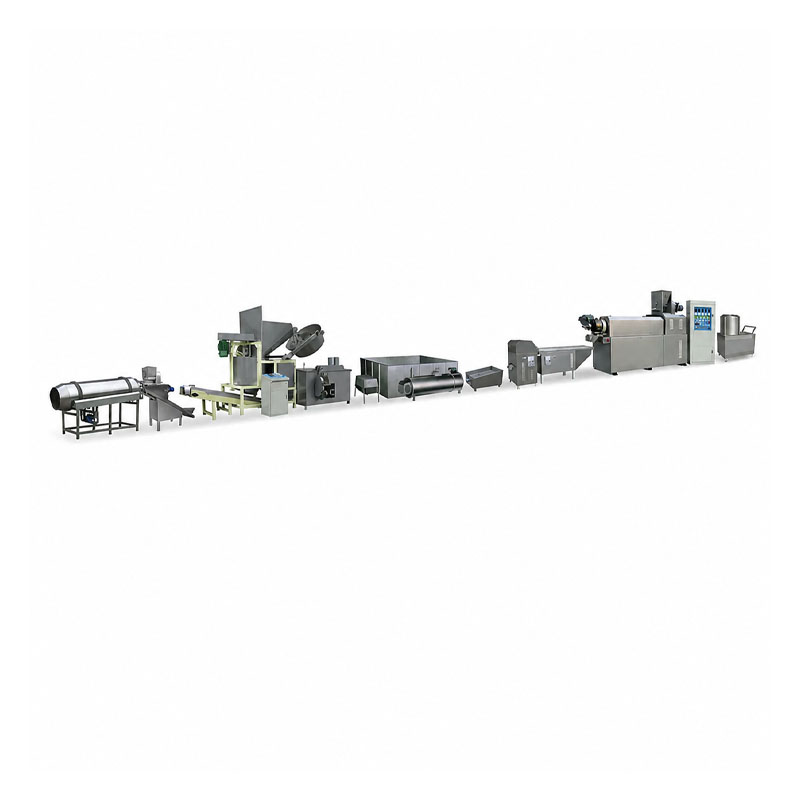

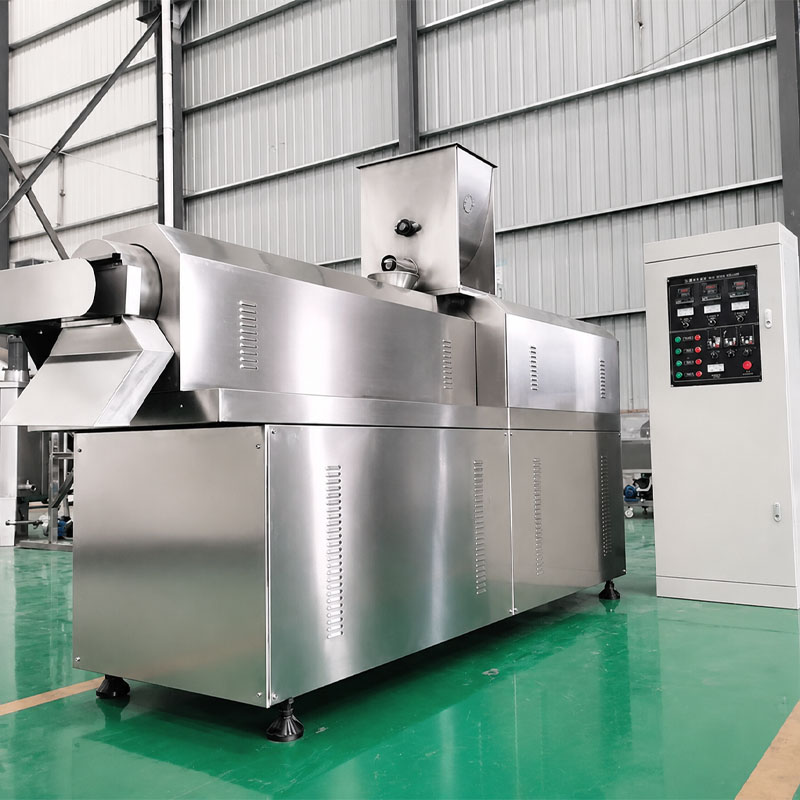
Puffed Snack Pellet Production Line for Crispy Chips Making
The Puffed Snack Pellet Production Line is an advanced production solution for creating diversified puffed snack products with various shapes and textures. It integrates material mixing, extrusion, shaping, drying, frying and seasoning processes into one continuous system. With flexible die replacement and precise process control, the line can produce flat 2D pellets and creative 3D snack structures. It supports multiple starch-based ingredients and helps manufacturers achieve efficient production with consistent product quality.
Compare
Product Introduction: Puffed Snack Pellet Production Line
The Puffed Snack Pellet Production Line is designed for manufacturers who need flexible and efficient solutions for producing modern puffed snack products. The complete system combines raw material preparation, extrusion cooking, forming, cutting, drying, frying and flavoring processes to create high-quality snack pellets.
Using advanced extrusion technology, the production line processes various flour and starch materials while maintaining stable cooking performance and uniform product structure. By changing forming dies and adjusting production parameters, manufacturers can produce a wide variety of 2D flat pellets and 3D shaped snacks, including rings, shells, tubes and customized designs.
The automated production system reduces manual operation and improves production consistency. It is suitable for producing ready-to-fry snack pellets, crispy chips and other expanded snack products. With flexible configuration options and reliable processing performance, this line helps snack producers expand product varieties and improve manufacturing efficiency.
Working Principle
The production line starts by mixing selected raw materials such as corn flour, wheat flour, potato starch and other ingredients into a consistent mixture. The material is then transported into the extrusion system, where mechanical pressure and controlled heating transform it into a flexible dough structure.
After extrusion, the dough passes through forming dies to create different 2D or 3D snack shapes. The cutting system adjusts the product size according to production requirements. The formed pellets are cooled and dried to achieve proper moisture content and stability. Before packaging, the semi-finished pellets can be fried and seasoned to obtain the desired crispy texture and flavor. The complete process is controlled automatically to ensure stable production quality.
System Structure
1. Mixing Unit
Ensures uniform blending of raw materials before processing.
2. Conveying System
Provides stable transportation between each production section.
3. Extrusion Unit
Processes and cooks materials while forming the basic snack structure.
4. Forming Unit
Creates different 2D and 3D shapes through customized molds.
5. Cutting System
Controls product length, size and appearance.
6. Drying System
Reduces moisture content and improves product stability.
7. Frying System
Expands dried pellets and creates crispy snack texture.
8. Seasoning System
Applies flavor powder or seasoning materials evenly onto finished snacks.
Production Process
1. Raw Material Mixing
Flour, starch and other ingredients are accurately mixed to create a uniform material base.
2. Screw Conveying
The prepared mixture is transferred smoothly into the extrusion system for continuous processing.
3. Extrusion Cooking
The material is cooked and processed under controlled pressure and temperature to form a stable dough structure.
4. Shaping and Cutting
The extruded material is formed into different 2D or 3D pellet shapes through customized dies and cutting units.
5. Cooling Process
Products are cooled after forming to stabilize their structure before further processing.
6. Drying Process
Moisture is reduced through controlled drying to improve storage stability and frying performance.
7. Frying and Expansion
Dried pellets expand during frying to achieve crispy texture and attractive appearance.
8. Seasoning and Packaging
Finished snacks can be flavored and packed automatically for commercial production.
Technical Parameters
| Parameter | Specification |
| Production Capacity | 250–300 kg/h |
| Installed Power | 178 kW |
| Power Consumption | 125 kW |
| Production Line Length | 30000 mm |
| Production Line Width | 2000 mm |
| Production Line Height | 2000 mm |
| Processing Type | Extrusion, forming, drying and frying |
| Product Type | 2D and 3D snack pellets |
| Automation Level | Automatic continuous production |
| Application | Puffed snack and pellet food production |
Main Features
Flexible Product Design
Supports different dies and forming methods to produce various snack shapes and sizes.
Advanced Extrusion Technology
Provides stable cooking and forming performance for consistent pellet quality.
Wide Ingredient Compatibility
Processes various flour and starch materials for diversified snack production.
Automatic Continuous Operation
Integrates multiple processing stages to improve production efficiency and reduce labor requirements.
Precise Process Control
Maintains stable temperature, pressure and processing conditions during production.
High Production Efficiency
Optimized workflow increases output while maintaining product consistency.
Easy Product Switching
Different snack styles can be achieved through simple die replacement and parameter adjustment.
Complete Processing Solution
Combines extrusion, forming, drying, frying and seasoning into one production system.
Applications
1. 2D Snack Pellet Production
Produces flat-shaped snack pellets with different patterns, sizes and structures for further frying or baking.
2. 3D Snack Product Manufacturing
Creates three-dimensional snack shapes with unique appearances through customized forming dies.
3. Crispy Snack Processing
Suitable for producing expanded snacks with excellent texture after frying or roasting.
4. Ready-to-Fry Pellet Production
Manufactures semi-finished pellets with controlled moisture content for convenient storage and final processing.
5. Snack Factory Production
Provides continuous processing solutions for small, medium and large snack manufacturers.
6. Customized Snack Development
Allows producers to create innovative snack products through flexible shaping and formulation adjustments.
7. Flavor Snack Manufacturing
Can be combined with seasoning systems to produce various flavored snack products.
Advantages
- produces multiple 2D and 3D snack shapes
- supports different flour and starch formulas
- improves production efficiency through automation
- provides stable extrusion and forming performance
- reduces manual operation requirements
- allows flexible product customization
- ensures consistent snack texture and quality
- suitable for fried and baked snack applications
FAQ
1. What products can this process line produce?
It can produce various 2D flat pellets and 3D shaped snack products for frying or baking.
2. What raw materials are suitable for this line?
It can process corn flour, wheat flour, potato starch, rice flour, tapioca starch and other similar materials.
3. Can the production line make different shapes?
Yes. Different dies and forming tools allow production of various snack designs.
4. Is the line fully automatic?
Yes. The system integrates multiple processing steps with automatic operation and control.
5. Can the products be flavored?
Yes. A seasoning system can be added for different flavor requirements.
6. What is the advantage of extrusion technology?
Extrusion provides uniform cooking, stable forming and consistent product quality.
7. Can the line produce both 2D and 3D pellets?
Yes. The same production system can switch between different pellet styles by changing dies.
8. Can the production capacity be customized?
Yes. The configuration can be adjusted according to product type and output requirements.
Contact us to get your quotation now.
Get in touch with our engineering team.
Related products
-
Puffed Food Equipment
3600pcs/h Puffed Rice Cake Machine – Snack Extruder Fast
This automatic puffed rice cake machine produces 3600–4800 pieces per hour from rice, corn, and other natural grains. It integrates extrusion, forming, and cooling for efficient, uniform production. Ideal for snack food factories and commercial kitchens, the machine ensures precise temperature control, consistent thickness, and shape. PLC-controlled operation simplifies workflow, while stainless steel construction guarantees hygiene, durability, and easy cleaning. It produces natural, additive-free puffed rice cakes suitable for retail and food service applications.
SKU: n/a -
Puffed Food Equipment
50kg/h Popcorn Ball Making Machine for Flavored Snack Food
This popcorn ball making machine is designed for producing flavored spherical popcorn snacks with a capacity of 50kg/h. The machine uses gas heating to cook and mix popcorn with syrup or seasoning, forming uniform popcorn balls. Built with stainless steel for durability and hygiene, it is suitable for snack shops, beverage stores, and small food processing factories requiring efficient and consistent popcorn snack production.
SKU: n/a -
Puffed Food Equipment
150kg/h Grain Snack Extruder – Corn Puff Food Processing
This grain snack extruder is designed for producing puffed snacks from corn, rice, wheat, millet, and other cereal grains with a capacity of 50–150 kg per hour. Using screw extrusion technology, the machine cooks and expands grains to create crispy snacks in various shapes such as rings, balls, sticks, and stars. It is suitable for snack food factories, small processing plants, and commercial cereal snack production.
SKU: n/a -
Puffed Food Equipment
3600-4800pcs/h Rice Cake Puff Extruder Machine Healthy Snacks
This rice cake puff extruder machine produces healthy puffed snacks from rice, corn, quinoa, oats, and other grains. It can create different shapes and thicknesses by changing molds, delivering additive-free, natural products. Suitable for industrial snack production lines, commercial healthy snack factories, and R&D labs, it ensures high output of 3600–4800 pieces per hour with consistent quality. Its compact design and simple operation provide efficient, safe, and hygienic processing for large-scale puffed snack manufacturing.
SKU: n/a


