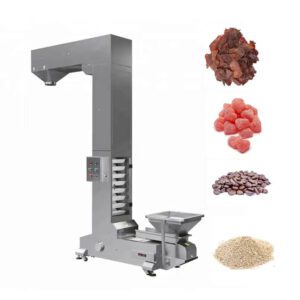
Manufacturer Dust Free Tubular Vibrating Conveyor System
Tubular Vibrating Conveyor is a closed-loop, dust-free material conveying system designed for horizontal and controlled-speed transport of powder, granules, and small bulk solids. It operates inside a sealed circular tube, preventing dust leakage while ensuring stable and continuous feeding. Widely used in food processing, chemical, mining, metallurgy, and construction industries, this vibrating feeder conveyor offers low energy consumption, low noise operation, and long service life. Its simple structure and easy maintenance make it ideal for automated material handling systems requiring clean and efficient conveying performance.
Compare
Tubular Vibrating Conveyor Product Introduction
Tubular Vibrating Conveyor, also known as enclosed vibrating feeder, circular tube conveyor, or dust-free vibration conveyor system, is designed for safe and efficient transportation of powdered, granular, and small block materials in closed environments. It is widely used for flour, sugar, grains, coal powder, fertilizer particles, cement, sand, gravel, chemicals, and food-grade materials.
The system works by using a vibration exciter to generate controlled oscillation along a sealed tube. Materials move forward due to a combination of vibration force and inertia, ensuring smooth and continuous conveying. The enclosed structure prevents dust emission and material contamination, making it highly suitable for hygienic and industrial applications.
With modular design, multi-point conveying capability, and low maintenance requirements, the tubular vibrating conveyor is a reliable solution for modern automated production lines.
Working principle
Step 1: Material Feeding
Powder or granular materials enter the sealed tubular conveyor inlet.
Step 2: Vibration Excitation
The vibration motor generates controlled oscillation along the tube body.
Step 3: Forward Material Movement
Friction force and vibration amplitude move materials forward continuously.
Step 4: Inertia-Based Conveying
Material maintains forward motion due to inertia during backward vibration phase.
Step 5: Continuous Circulation Transport
Repeated vibration cycles ensure stable and uninterrupted conveying flow.
Step 6: Material Discharge
Materials are discharged at the outlet into the next processing equipment.
Product Parameter Table
| Parameter | Specification |
| Capacity | 25 m³/h |
| Max. Conveying Length | 8 m |
| Max. Feeding Size | 100 mm |
| Rotate Speed | 1450 r/min |
| Power | (0.6-3) × 2 kW |
Tubular Vibrating Conveyor vs Other Conveying Systems
| Comparison Item | Tubular Vibrating Conveyor | Screw Conveyor | Belt Conveyor |
|---|---|---|---|
| Dust Control | Excellent | Good | Poor |
| Enclosed Design | Fully enclosed | Partially enclosed | Open |
| Energy Consumption | Low | Medium | Medium |
| Maintenance Cost | Low | Medium | Medium |
| Material Damage | Low | Medium | Low |
| Multi-point Feeding | Supported | Limited | Limited |
| Cleanliness Level | High | Medium | Low |
| Suitable for Powder | Excellent | Good | Limited |
Main Features
- Fully Enclosed Dust-Free Design
Prevents material leakage and improves working environment cleanliness. - Stable Vibration Conveying
Ensures smooth and continuous material transport without blockage. - Low Energy Consumption
Optimized vibration system reduces operational power usage. - Long Service Life Structure
Durable components ensure reliable industrial operation. - Low Noise Operation
Quiet working performance suitable for indoor production environments. - Easy Maintenance Design
Simple structure allows fast cleaning and inspection. - Flexible Installation Layout
Supports horizontal, inclined, and multi-point conveying systems. - Wide Material Compatibility
Handles powder, granules, flakes, and small bulk solids efficiently.
Why Choose Our Tubular Vibrating Conveyor
- Dust-Free Enclosed System
Ensures clean and safe operation for powder and granule handling. - Stable Continuous Conveying
Provides reliable material transport without clogging or leakage. - Energy Efficient Operation
Low power consumption reduces long-term operating costs. - Low Maintenance Requirement
Simple mechanical design reduces downtime and repair costs. - Wide Industrial Adaptability
Suitable for food, chemical, mining, and construction industries. - Flexible System Integration
Easily connects with silos, feeders, and packaging machines. - Long-Term Durability
High-quality materials ensure extended service life. - Safe and Reliable Operation
Enclosed design improves workplace safety and material purity.
Application Scenarios
- Food Industry
Used for flour, sugar, grains, candy, and food powder conveying. - Chemical Industry
Suitable for fertilizers, additives, pigments, and chemical powders. - Mining Industry
Handles coal powder, ore particles, and mineral materials. - Construction Materials
Used for cement, sand, gravel, and dry mortar transport. - Metallurgy Industry
Suitable for metal powder and industrial raw material conveying. - Agricultural Processing
Used for grain, feed, and seed transportation systems.
Buying Guide
- Confirm Material Type
Identify whether material is powder, granule, or small bulk solid. - Determine Conveying Capacity
Select appropriate tube diameter and vibration power for output needs. - Check Installation Layout
Confirm horizontal, inclined, or multi-point conveying requirements. - Choose Material Construction
Select stainless steel for food grade or carbon steel for industrial use. - Evaluate System Integration
Ensure compatibility with feeders, silos, and packaging equipment.
FAQ
Q1: What materials can a tubular vibrating conveyor transport?
A: It can transport flour, grains, sugar, cement, coal powder, fertilizer, and granules.
Q2: Is the conveyor suitable for dusty materials?
A: Yes, its fully enclosed design effectively prevents dust leakage.
Q3: Can it be used in food industry applications?
A: Yes, stainless steel models are widely used in food-grade processing lines.
Q4: Does the conveyor require high maintenance?
A: No, it has a simple structure with low maintenance requirements.
Q5: How does the vibration conveyor move materials?
A: It uses vibration and inertia to push materials forward inside the tube.
Q6: Can it handle continuous production?
A: Yes, it is designed for stable continuous industrial operation.
Q7: Is it suitable for multi-point feeding systems?
A: Yes, it can be integrated into multi-point conveying layouts.
Q8: What industries commonly use it?
A: Food, chemical, mining, metallurgy, and construction industries.
Q9: Does it consume a lot of power?
A: No, it has low energy consumption compared to other conveyors.
Q10: Can the system be customized?
A: Yes, tube length, diameter, and capacity can be customized.
Conclusion
Tubular Vibrating Conveyor is an efficient, dust-free, and reliable solution for transporting powder, granules, and bulk materials in modern industrial production. With its enclosed structure, low energy consumption, stable vibration conveying, and wide material compatibility, it is widely used in food, chemical, mining, and construction industries. Its simple maintenance, flexible layout, and high safety performance make it an ideal choice for automated material handling and continuous production line systems.
Contact us to get your quotation now.
Get in touch with our engineering team.
Related products
-
Conveyors & Feeding Elevator
food grade stainless steel 304 mesh belt conveyor for beer equipment
For our mesh belt conveyor,It is suitable for long-distance, material handing under fixed scene. It is simple and easy to assemble with low noise,easy maintenance, high efficiency. For conveyor belt, there are plastic module belt ,stainless steel mesh belt, chain rod belt ,chain plate and so on.We can make it based your drawing. or our engineer will make the exact auto CAD drawing in 3-5 days once we make the deal. In addition , we may revise the the drawing according to our clients’ feedback untill everything is fixed by both parties .We are confident of the quality of our product and the service of our team.
SKU: n/a -
Conveyors & Feeding Elevator
Screw Conveyor Spiral Cement Auger
- This screw conveyor is a customizable machine. We can design and manufacture a screw conveyor according to customers’ specific requirements.
- The screw conveyor also be called as other name in different country, for example, sometimes will also named it as pipe screw conveyor; auger conveyor; trough shaped screw conveyor; screw feeder; U-type screw conveyor and so on.
- Using seamless steel pipe, good sealing
- Thickened blade, durable, wear resistant
- Simple structure, convenient cleaning and maintenance
- Using external bearing chamber to avoid material entering
SKU: n/a -
Conveyors & Feeding Elevator, Material Handling & Storage
Rubber sanding belt conveyor belt PVC conveyor belt seamless round conveyor belt (2 pieces) sanding belt machine belt rubber timing belt
 Conveyors & Feeding Elevator, Material Handling & Storage
Rubber sanding belt conveyor belt PVC conveyor belt seamless round conveyor belt (2 pieces) sanding belt machine belt rubber timing belt
- Material: Rubber
- Model: 3M-354-9
- Size: 5inch
- Compatible with: Super Recycler Lawn Mower.
- Effect: Improve Your Tractors Torque and Maneuverability.
SKU: n/a -
Conveyors & Feeding Elevator
Industrial conveyor automatic z type conveyor bucket elevator for grain,snacks,nuts food grade conveyor
Conveyors & Feeding ElevatorIndustrial conveyor automatic z type conveyor bucket elevator for grain,snacks,nuts food grade conveyor
The conveyor is applicable for vertical lifting of granule material such as corn,jerry, snack, candy , nuts, plastic and chemical product, small hardware ,vegetable ,fruit and so on. For this machine, the bucket is driven by the chains to lift.
SKU: n/a