Low Maintenance Bucket Elevator for Feed Pellet Handling
The Bucket Elevator is a reliable vertical conveying solution designed for efficient lifting of powder, granular, and bulk materials. With low power consumption, stable operation, and high lifting capability, it minimizes material return and damage during transportation. Its sealed structure and flexible configuration make it suitable for chemical, mining, metallurgy, food, ceramic, and industrial applications requiring continuous material feeding and transfer.
Compare
Bucket Elevator Product Introduction
The Bucket Elevator is an efficient vertical material conveying system designed to transport powder, granular, and bulk materials to different heights with stable and continuous operation. It adopts an optimized feeding and discharge design to reduce material return, spillage, and unnecessary power consumption during the conveying process.
With excellent sealing performance and reliable mechanical structure, this elevator provides smooth material handling while reducing environmental pollution and maintenance requirements. It can handle various materials with different characteristics, including fine particles, powders, and abrasive products.
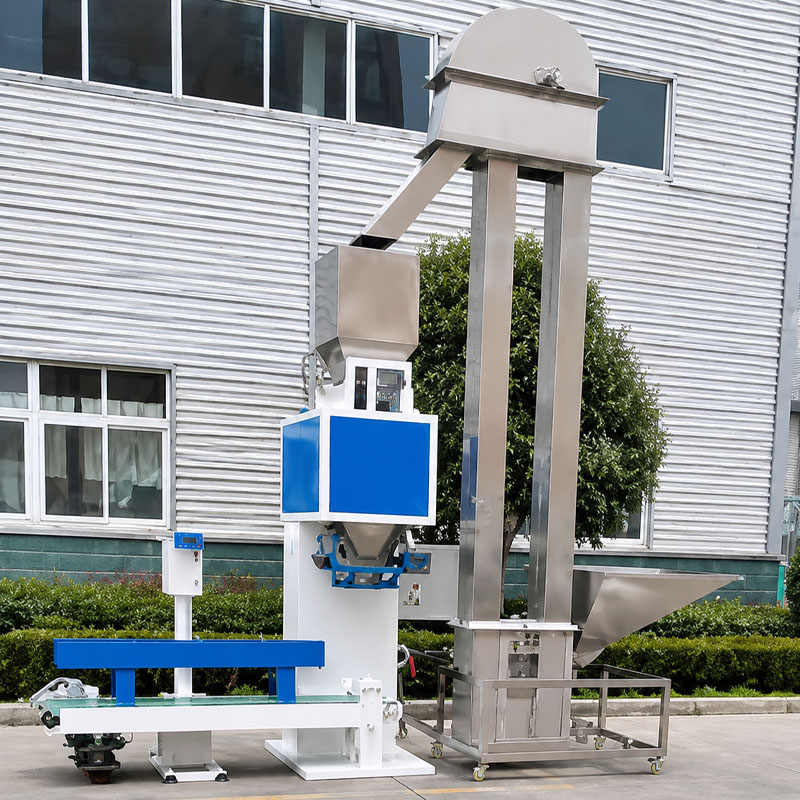
The bucket conveying system offers high lifting height, flexible capacity options, and long service life, making it widely used in chemical, mining, metallurgy, ceramic, food processing, fertilizer, and industrial production lines. It can operate independently or integrate with packaging machines, storage systems, and automated production equipment to achieve efficient vertical material transfer.
Working principle
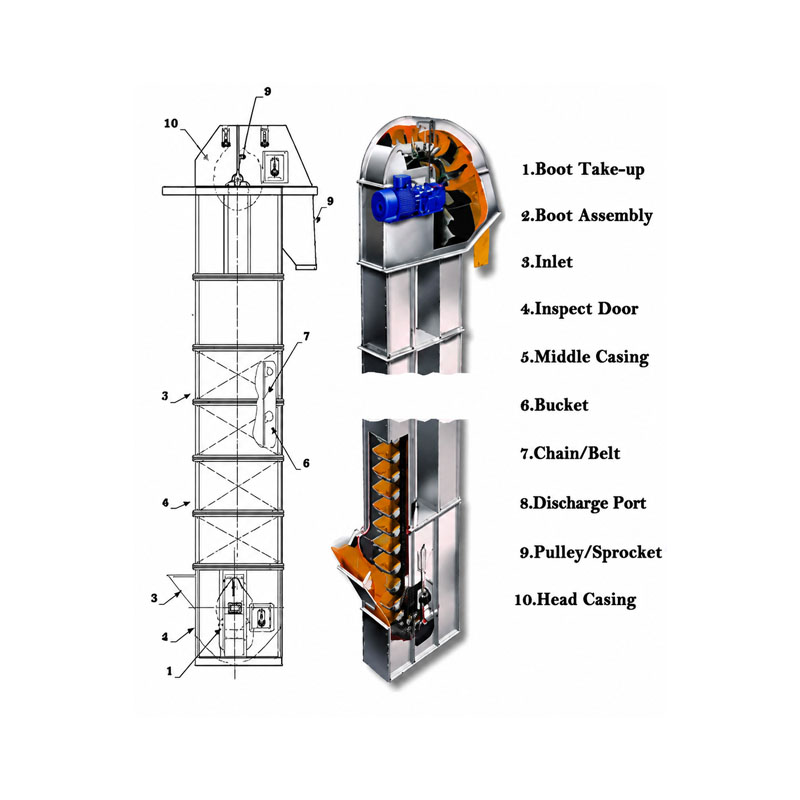
The Bucket Elevator operates by using a series of buckets attached to a belt or chain mechanism to continuously lift materials vertically. Materials enter through the feeding section and are collected by moving buckets, which transport them upward inside the enclosed casing. When reaching the discharge section, materials are released smoothly through controlled unloading. The empty buckets return to the feeding point to repeat the cycle, ensuring continuous, stable, and efficient material conveying with minimal material loss.
System Structure
Feeding Section
The feeding section provides continuous and stable material input while reducing blockage and material accumulation during operation.
Bucket Assembly
The bucket assembly consists of multiple buckets connected to the conveying mechanism for efficient vertical material lifting.
Belt or Chain Drive System
The drive mechanism provides continuous movement of buckets and ensures reliable material transportation.
Vertical Casing
The enclosed casing supports the lifting structure, protects internal components, and helps maintain a clean working environment.
Discharge Section
The discharge section controls material release and ensures smooth transfer to downstream equipment.
Drive Unit
The drive unit provides stable power output for continuous operation and adjustable conveying performance.
Working Process
Step 1: Material Feeding
Bulk materials are continuously fed into the inlet of the bucket elevator through manual loading or upstream processing equipment. The optimized feeding structure ensures stable material entry and reduces material accumulation or blockage.
Step 2: Bucket Loading and Vertical Lifting
The moving buckets collect materials from the feeding section and transport them upward along the enclosed casing. The drive system provides continuous power to ensure smooth bucket movement and efficient vertical conveying.
Step 3: Material Discharge
When the buckets reach the top discharge section, materials are released smoothly through controlled unloading. The discharge design helps reduce material return and prevents unnecessary loss during transportation.
Step 4: Bucket Return Cycle
After unloading, the empty buckets return to the bottom section through the return path to complete the next conveying cycle, ensuring continuous and stable operation.
Step 5: Material Transfer to Production System
The lifted materials are transferred to storage tanks, packaging machines, processing equipment, or other production systems to achieve automatic and efficient material handling.
Product Parameter Table
| Parameter | Specification |
|---|---|
| Conveying Type | Vertical Bucket Elevator |
| Bucket Speed | 0.5 m/s |
| Material Size | 50–195 mm |
| Bucket Capacity | 2.5–501.8 L |
| Conveying Capacity | 15–800 m³/h |
| Application Material | Powder, Granular and Bulk Material |
| Discharge Method | Controlled Material Discharge |
| Application | Chemical, Mining, Food, Ceramic and Industrial Handling |
Main Features
- Low power consumption design reduces energy usage during continuous operation
- Efficient feeding structure minimizes material return and improves conveying performance
- High lifting capability supports vertical transportation over extended distances
- Reliable operation ensures stable performance with reduced downtime requirements
- Sealed conveying structure helps prevent dust leakage and environmental pollution
- Suitable for powder, granular, and abrasive material transportation applications
- Gentle material handling reduces collision, extrusion, and product damage
- Durable construction provides long service life and lower maintenance costs
- Flexible capacity options meet different production line requirements
- Smooth discharge design reduces material loss during unloading process
Advantages
High Conveying Efficiency
The optimized bucket design enables continuous material lifting with stable output.
Reduced Material Damage
Smooth feeding and discharge processes help protect product quality.
Energy Saving Operation
Low power consumption design helps reduce operating costs.
Long Service Life
Durable components and reduced mechanical wear improve equipment reliability.
Wide Material Compatibility
Suitable for different powders, granules, and bulk materials across multiple industries.
Application Scenarios
Chemical Industry
Used for transporting powders, particles, and chemical materials in production and processing systems.
Mining Industry
Suitable for lifting minerals, ores, and abrasive bulk materials during processing operations.
Metallurgical Industry
Applied for vertical transfer of industrial materials requiring stable and continuous conveying.
Food Processing Industry
Used for handling grains, powders, and food ingredients with reliable material flow.
Ceramic Industry
Suitable for transporting ceramic powders and granular materials in manufacturing processes.
Fertilizer Production
Provides efficient vertical conveying for fertilizer particles and bulk materials.
Packaging Production Line
Can be integrated with packaging equipment to provide automatic material feeding solutions.
Suitable Materials
- powder material
- granular material
- grain
- fertilizer
- mineral
- ceramic powder
- chemical particle
- industrial material
- bulk material
- abrasive material
FAQ
Q1: What materials can the bucket elevator handle?
The bucket elevator can transport various powder, granular, and bulk materials, including grain, fertilizer, minerals, chemical particles, ceramic materials, and industrial products.
Q2: What are the advantages of using a bucket elevator?
It provides efficient vertical conveying, low energy consumption, stable operation, high lifting height, and reduced material loss during transportation.
Q3: How high can the bucket elevator lift materials?
The lifting height can be customized according to application requirements, making it suitable for different production lines and installation conditions.
Q4: Can the bucket elevator handle abrasive materials?
Yes. The durable structure and suitable bucket design allow it to handle abrasive materials such as minerals, aggregates, and industrial particles.
Q5: How does the bucket elevator reduce material damage?
The optimized feeding and discharge design minimizes material collision, extrusion, and return during the conveying process.
Q6: Is the bucket elevator suitable for continuous operation?
Yes. It is designed for reliable continuous operation with stable material flow and reduced maintenance requirements.
Q7: What industries use bucket elevators?
Bucket elevators are widely used in chemical, mining, metallurgy, ceramic, food processing, fertilizer, and manufacturing industries.
Q8: Can the bucket elevator be integrated into an automated production line?
Yes. It can be connected with packaging machines, storage systems, and other production equipment to achieve automatic material feeding and transfer.
Contact us to get your quotation now.
Get in touch with our engineering team.
Related products
-
Conveyors & Feeding Elevator
Sell like hot cakes roller table support custom bend conveyors for automatic conveying line,Applicable to manufacturing plants, food and beverage factories
 Conveyors & Feeding Elevator
Sell like hot cakes roller table support custom bend conveyors for automatic conveying line,Applicable to manufacturing plants, food and beverage factories
The chain plate conveyor is a transmission device with a standard chain plate as the bearing surface and a motor reducer as the power transmission. Chain plate conveyor is composed of power unit, transmission shaft, roller, tensioning device, sprocket, chain, bearing, lubricant, chain plate and so on.
SKU: n/a -
Conveyors & Feeding Elevator
industrial mobile belt conveyor for coal/bulk material/sand gravel stone transporting
Conveyors & Feeding Elevatorindustrial mobile belt conveyor for coal/bulk material/sand gravel stone transporting
Our advantages on belt conveyor:
1).OEM service.
2).More than 30 years experience of conveying industry.Specialized in various conveyors(0-90 degree transportation),like Mobile Belt Conveyor,Fixed Belt Conveyor,Screw Conveyor,PVC Belt Conveyor,PVC(Rubber) Sidewall Belt Conveyor etc.
3).Delivery on time.
4).3% to 10% discounts for new customer(Based on the quantity.)
5).Professional engineer team help you to choose best model for your projectSKU: n/a