3000L Industrial Mixing Tank Supplier for Beverage Processing
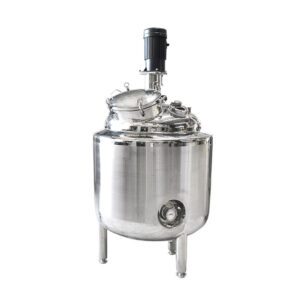
The 3000L industrial mixing tank is a stainless steel blending system designed for efficient liquid processing, homogenization, and large-scale industrial mixing. It is widely used in food and beverage production, chemical manufacturing, cleaning solutions, and energy applications. With corrosion-resistant construction and a jacketed heating and cooling system, it ensures stable performance and precise process control. The advanced agitator supports uniform blending of low to high viscosity materials, making it a reliable solution for industrial mixing, processing, and production systems.
Compare
Product Introduction of Industrial Mixing Tank
The 3000L industrial mixing tank is a high-performance liquid processing and blending system designed for large-scale production in food and beverage manufacturing, cleaning product formulation, and energy-related industries. It integrates advanced mixing technology with a robust stainless steel structure to ensure efficient homogenization, stable processing performance, and long service life.
Built with precision engineering, this industrial blending vessel supports a wide range of applications involving liquids, emulsions, and semi-solid materials. Its customizable design allows manufacturers to adapt the system to different production requirements, ensuring consistent quality and operational efficiency.
Working principle
Step 1: Feeding and material circulation
Raw materials are introduced into the stainless steel mixing vessel through inlet ports. The closed system ensures controlled feeding of liquids, powders, or semi-solid materials, enabling stable industrial processing conditions.
Step 2: Agitation and homogenization process
The motor-driven top-mounted agitator transfers power through a shaft and coupling system, generating axial and radial flow. Different impeller types (turbine, anchor, frame) create strong circulation, ensuring uniform blending, dispersion, and homogenization of materials at adjustable speeds (0–60 rpm).
Step 3: Temperature control and discharge operation
The jacket system circulates heating or cooling media to maintain precise process temperature during mixing. After completion, the sloped-bottom structure ensures complete discharge without residue, improving production efficiency and reducing material waste in industrial operations.
Product Parameter Table
| Parameter Item | Specification |
| Effective Volume | 1500 L |
| Total Volume | 1875 L |
| Size | 1260 × 2400 mm |
| Material | SUS304 / SUS316 |
| Control System | PLC Siemens or PID Schneider/ABB Brand |
| Cooling Area | 2.7 m² |
| Working Pressure | Inner Jacket 0.4 MPa; Cooling Jacket 0.5 MPa |
| Design Pressure | Inner Jacket 0.2 MPa; Cooling Jacket 0.3 MPa |
Industrial Mixing Tank vs Standard Storage Tank
- standard tank: only storage functionindustrial system: active mixing and processing capability
- standard tank: poor homogenization performanceindustrial system: optimized agitator ensures uniform blending
- standard tank: no temperature controlindustrial system: jacket heating and cooling support
- standard tank: residue accumulation riskindustrial system: sloped bottom ensures full discharge
Stainless Steel Mixing System vs Carbon Steel Tank
- carbon steel: corrosion-prone in chemical environments
stainless system: high resistance to acids and cleaning agents - carbon steel: limited hygiene performance
stainless system: food-grade mirror-polished surface
Main Features
- Mirror-polished inner surface Ra≤0.4μm for hygienic processing
- SUS304 or SUS316L stainless steel construction for corrosion resistance
- Flexible jacket design for heating and cooling control options
- High-efficiency agitator system for uniform material blending
- Multiple impeller types including turbine, anchor, and frame design
- Bottom sloped structure ensures complete discharge without residue
- Insulated tank body reduces heat loss and improves energy efficiency
- Integrated control system for temperature, level, and pressure monitoring
- Easy-clean design with arc-welded smooth transitions
- Customizable ports for feeding, sampling, sterilization, and discharge
Application Scenarios
For inconsistent food production mixing
this industrial blending system ensures uniform ingredient distribution, resulting in stable product taste and consistent quality.
For cleaning solution formulation instability
this stainless steel mixing vessel delivers controlled agitation, resulting in balanced chemical concentration and improved product performance.
For energy liquid processing inefficiency
this large-capacity tank improves mixing dynamics, resulting in higher processing efficiency and reduced production downtime.
For high-viscosity material blending difficulty
this optimized agitator system enhances shear force, resulting in faster homogenization and reduced mixing time.
For industrial batch variation problems
this controlled mixing environment stabilizes process conditions, resulting in repeatable and reliable batch output.
Why Choose This Industrial Mixing System
- Higher mixing uniformity than conventional blending tanks
- Better corrosion resistance compared to carbon steel reactors
- More stable temperature control than non-jacketed systems
- Easier cleaning than standard welded storage vessels
- More flexible configuration than fixed-speed mixers
- More consistent batch quality than manual mixing processes
FAQ
What is a 3000L industrial mixing tank used for in manufacturing?
It is used for large-scale blending, homogenization, and processing of liquids and semi-solid materials in industrial production.
How does a stainless steel mixing tank improve production efficiency?
It ensures uniform mixing, reduces processing time, and improves batch consistency in continuous manufacturing systems.
What industries use large capacity mixing vessels?
It is widely used in food processing, beverage production, cleaning product manufacturing, and energy-related industries.
Can industrial mixing tanks handle high viscosity materials?
Yes, they can be equipped with different impeller designs to efficiently process thick or semi-solid materials.
Why is a jacketed mixing system important in industrial processing?
It provides precise heating and cooling control, improving reaction stability and production quality.
What is the benefit of mirror polished tank surfaces?
It reduces material adhesion, improves hygiene, and simplifies cleaning in industrial operations.
How does bottom discharge improve mixing tank performance?
It ensures complete material removal without residue, improving production efficiency and batch accuracy.
Contact us to get your quotation now.
Get in touch with our engineering team.
Related products
-
Mixing Tanks
200L Stainless Steel Acid And Alkali Resistant Chemical Mixing Tank with Agitator
The 200 L stainless steel mixing tank is expertly engineered for both laboratory and industrial applications where reliable chemical processing is essential. Constructed from high-quality stainless steel, it provides exceptional resistance to acids and alkalis, ensuring long-lasting durability even with harsh or reactive substances. The built-in agitator delivers consistent, uniform blending for liquids of varying viscosities, helping maintain product quality and homogeneity. Designed with safety and ease of operation in mind, this tank offers a robust, low-maintenance solution for chemical mixing, food production, pharmaceutical preparation, and other demanding environments.
SKU: n/a -
Mixing Tanks
500L Industrial And Chemical Mixing Tanks
There are many choices when it comes to selecting a mixing tank or vessel material. For different situations, you can choose different materials;Two main types of mixing tanks, plastic and metal:
- Poly mixing tanks include High Density Polyethylene (HDPE), Polypropylene (PP), Polyvinylidene (PVDF) and Teflon (PTFE).
- Metal tanks are usually 304 Stainless Steel, 316L Stainless Steel, . We will be focusing on selecting tanks for sanitary or food grade;
Note: Prices may vary depending on product capacity and quality.
SKU: n/a -
Food Processing Industry, Mixing Tanks
500L Heavy Duty Mixing Tank insulated stainless steel tank with lids
 Food Processing Industry, Mixing Tanks
500L Heavy Duty Mixing Tank insulated stainless steel tank with lids
The structure of the stirring tank The stirring tank is composed of a stirring tank body, a stirring tank cover, an agitator, a support, a transmission device, a shaft sealing device, etc., and a heating device or a cooling device can also be configured according to the process requirements.
SKU: n/a