Tomato Paste Processing Line Solution Industrial System
The tomato paste processing line is an advanced industrial solution designed to convert fresh tomatoes into high-quality paste, puree, and juice products. It integrates washing, crushing, hot break heating, evaporation, sterilization, and aseptic filling in a continuous automated system. Built with SUS304 stainless steel and PLC control, it ensures hygienic production, stable operation, and high concentration output of 28–30 Brix. The system is ideal for large-scale food processing factories seeking efficiency and consistent product quality.
Compare
Product introduction from Tomato Paste Processing Line
The tomato paste processing line is a fully automated industrial system engineered for large-scale tomato transformation into paste, puree, juice, and concentrate products.
With a processing capacity of 6 tons per hour, the system integrates washing, sorting, crushing, pre-heating, evaporation, sterilization, and aseptic drum filling. It is designed for continuous 24-hour production, ensuring stable output and consistent quality.
Built with SUS304 stainless steel and equipped with PLC automation, it meets international food safety standards while supporting energy-efficient and high-yield tomato processing operations.
Working principle
Step 1. Raw tomato reception and washing
Fresh tomatoes are received and cleaned using high-pressure water systems to remove impurities.
Step 2. Sorting and inspection
Defective or unqualified tomatoes are removed to ensure consistent raw material quality.
Step 3. Crushing and pulping
Tomatoes are crushed into slurry for further processing.
Step 4. Hot break heating process
Enzymes are inactivated to preserve color and viscosity of tomato paste.
Step 5. Pulp refining and separation
Skin, seeds, and solid particles are removed through refining equipment.
Step 6. Vacuum evaporation concentration
Water is removed under controlled conditions to achieve 28–30 Brix paste concentration.
Step 7. Sterilization process
High-temperature sterilization ensures microbial safety and product stability.
Step 8. Aseptic filling system
Final tomato paste is filled into aseptic drums (5–220L) for long-term storage.
Product Parameter Table
| Raw material | Fresh tomato(about 4.5brix) |
| End product | Tomato paste (28~30brix) |
| Processing capacity | 6 t/h based on fresh tomato |
| Daily Output | 17~20 t/day(24 hours) |
| Packaging | Aspect drum(5~220 L) |
| Total power | 220 kW |
| Steam Consumption | 3.5-4.2 t/h |
| Water Consumption | 15-20 t/h |
| Cooling circulating water consumption |
180-250 t/h( inlet temperature: 32℃;outlet temperature:38℃) |
Comparison Module
| Feature | Modern Tomato Paste Line | Traditional Processing |
|---|---|---|
| Automation | Fully PLC controlled system | Manual/semi operation |
| Concentration Efficiency | 28–30 Brix stable output | Unstable concentration |
| Energy Consumption | Waste heat recovery system | High energy loss |
| Hygiene Level | SUS304 + CIP cleaning | Basic sanitation |
| Production Mode | Continuous 24-hour system | Batch processing |
| Product Output | Multi-product (paste, juice, sauce) | Single product type |
Main Features
- Fully automated tomato processing and paste production system
- High-efficiency crushing and hot break technology improves paste quality
- Continuous evaporation system increases concentration to 28–30 Brix
- SUS304 stainless steel structure ensures hygiene and durability
- PLC intelligent control system ensures stable production operation
- Waste heat recovery system improves energy efficiency
- CIP cleaning system ensures food safety compliance
- Flexible output for paste, puree, juice, and canned tomato products
Application Scenarios
For tomato farms
For seasonal tomato surplus → result: convert fresh tomatoes into high-value paste for long-term storage.
For food processing factories
For unstable raw material supply → result: ensure continuous production of standardized tomato products.
For export manufacturers
For strict food safety requirements → result: meet international quality standards for global markets.
For beverage and sauce industries
For diversified product demand → result: produce paste, juice, sauce, and canned tomato products on one line.
For industrial food plants
For high energy consumption and low efficiency → result: reduce cost with automated continuous processing system.
Why Choose This Solution
- Turnkey tomato paste production solution from raw fruit to final packaging
- High automation reduces labor dependency and operational cost
- Continuous production ensures stable industrial output
- High concentration efficiency improves product profitability
- Hygienic SUS304 design ensures global food safety compliance
- Energy-saving system reduces steam and water consumption
- Flexible system supports multiple tomato-based products
FAQ
What is a tomato paste processing line used for in food industry?
It is an industrial system that converts fresh tomatoes into paste, puree, and juice through automated processing and evaporation.
How does tomato paste production line work step by step?
It includes washing, crushing, hot break heating, evaporation, sterilization, and aseptic filling processes.
What is the capacity of industrial tomato paste processing line?
The system can process up to 6 tons of fresh tomatoes per hour.
What is the final Brix level of tomato paste production line?
The final tomato paste concentration is typically 28–30 Brix.
What equipment is included in tomato paste production system?
It includes washing machines, crushers, evaporators, sterilizers, and aseptic filling machines.
How much water and steam does tomato processing line consume?
Steam consumption is 3.5–4.2 t/h and water consumption is 15–20 t/h depending on operation scale.
Contact us to get your quotation now.
Get in touch with our engineering team.
Related products
-
Fruit And Vegetable Processing Line
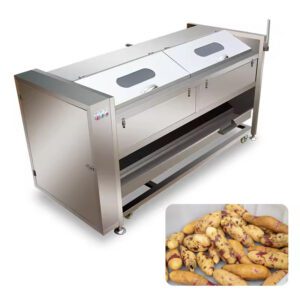
Brush Washer Peeler Machine Automatic Commercial Avocado Kiwi Fruit Yam Cassava Taro Potatoes Peeling Machine
 Fruit And Vegetable Processing Line
Brush Washer Peeler Machine Automatic Commercial Avocado Kiwi Fruit Yam Cassava Taro Potatoes Peeling Machine
The Sealed cover peeling machine issuitable for cleaning and peeling round and ovalfruits and vegetables such as ginger, carrot, taro, potato, sweet potato and other root vegetables.
The cleaning brush is a nylon cord rolledmaterial treated by a special process, and thepeeling is a hardened material, which has verygood wear resistance.
The whole machine is made of high-quality stainless steel material, and the materi-al can rotated outside. The bottom of the machine is equipped with an isolation filternetwork to effectively separate waste residue and waste water.
SKU: n/a -
Food & Beverage Processing Equipment, Fruit And Vegetable Processing Line
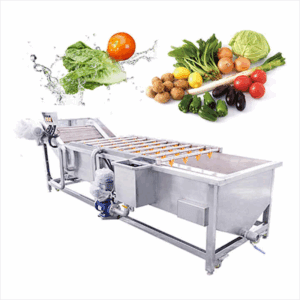
QX-400 High-Efficiency Vegetable Pretreatment Equipment, 304 Stainless Steel
Food & Beverage Processing Equipment, Fruit And Vegetable Processing LineQX-400 High-Efficiency Vegetable Pretreatment Equipment, 304 Stainless Steel
Model: QX-400
Capacity: 800-1000 kg/h
Overall size: 4000*1300*1250 mm
Power: 4.6 kW
Voltage: 380 V 50 Hz
Conveyor width: 800 mm
Conveyor material: stainless steel 304SKU: n/a -
Fruit And Vegetable Processing Line
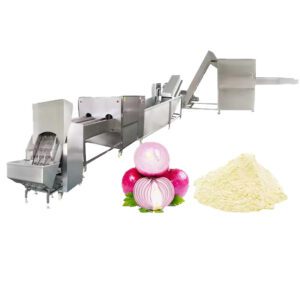
Onion Powder Making Machine Onion Dryer Machine Ginger Powder Processing Line
Fruit And Vegetable Processing LineOnion Powder Making Machine Onion Dryer Machine Ginger Powder Processing Line
Feeding Conveyor:0.75KW
Picking line:0.75KW
Onion Root Cutting Machine:1.86KW
Feeding Conveyor:0.75KW
Chain Type Onion Peeling Machine:0.75KW
Air compressor set:37KW
Feeding Conveyor:0.75KW
Onion cutting machine:0.75KW
Feeding Conveyor:0.75KW
Bubble Washing machine:6KWSKU: n/a