PP Corrugated Sheet Extrusion Line Supplier | PP Sheet Machine
The PP corrugated sheet extrusion line is a high-efficiency industrial production system designed to manufacture polypropylene hollow sheets, also known as corrugated plastic sheets or twin-wall boards.
This extrusion line converts raw polypropylene (PP) materials into lightweight, durable, and high-strength sheets through a continuous extrusion process. These sheets are widely used in packaging systems, advertising boards, construction protection panels, and logistics industries.
Compared with traditional materials such as cardboard and wood, PP corrugated sheets offer superior durability, moisture resistance, and recyclability, making them an ideal solution for modern industrial applications.
Compare
Extrusion Line System Overview
A complete PP sheet extrusion line typically includes:
- Raw material feeding & mixing system
- Single screw or twin screw extruder
- T-die (sheet forming mold)
- Vacuum calibration table
- Cooling system (water/air cooling)
- Haul-off unit (traction system)
- Cutting machine (automatic length control)
- Stacking system
👉 These components work together to ensure continuous, stable, and high-quality production.
Working Principle
The PP sheet extrusion process follows a continuous thermoplastic forming principle:
- Feeding
Polypropylene raw materials (pellets, recycled PP, additives) are mixed and fed into the extruder - Melting & Plasticizing
The material is heated and melted inside the extruder through screw rotation and heating zones - Extrusion Forming
The molten polymer is pushed through a die to form a sheet profile - Corrugated Structure Formation
The sheet passes through a forming system to create a hollow corrugated structure - Cooling & Shaping
Vacuum calibration and cooling ensure dimensional stability - Haul-off & Cutting
The sheet is pulled and cut into required sizes automatically
👉 This continuous process ensures high output and consistent quality.
Product Features
🔹 High Efficiency Production
- Continuous extrusion process with stable output
- High-speed production improves ROI
🔹 Lightweight & High Strength
- Corrugated structure provides high rigidity with low weight
- Reduces material consumption
🔹 Excellent Chemical Resistance
- Resistant to acids, alkalis, and corrosion
- Suitable for harsh environments
🔹 Energy Saving Design
- Optimized screw and heating system reduce energy consumption
🔹 Easy Operation
- PLC automatic control system
- Touch screen interface
🔹 Eco-Friendly & Recyclable
- 100% recyclable PP material
- Supports sustainable manufacturing
Application Scenarios
PP corrugated sheets produced by this machine are widely used in:
📦 Packaging Industry
- Turnover boxes
- Protective packaging
- Pallet layers
🏗 Construction Industry
- Floor protection boards
- Formwork panels
📢 Advertising Industry
- Sign boards
- Display panels
🚗 Automotive Industry
- Interior panels
- Protective partitions
🧊 Logistics & Storage
- Warehouse separators
- Reusable containers
👉 PP sheets are increasingly replacing traditional materials due to their durability and recyclability.
Production Process Description
Raw Material Mixing → Feeding → Extrusion → Sheet Forming → Cooling → Cutting → Stacking
👉 Fully automated process ensures high efficiency and minimal labor cost
Technical Parameters
| Model | Sheet Width (mm) | Output (kg/h) | Extruder | Motor Power (kW) |
|---|---|---|---|---|
| 1400 | 1250 | 170–190 | 110/36 | 75–90 |
| 1860 | 1700 | 190–250 | 120/36 | 90–110 |
| 2300 | 2150 | 260–300 | 120/36 | 110–132 |
| 2600 | 2450 | 300–350 | 120/36 | 132–160 |
| 3000 | 2800 | 400–450 | 150/36 | 132–185 |
👉 Data can be customized based on production requirements
Why This System Is Designed This Way
This PP sheet extrusion line is engineered to balance:
- High production efficiency
- Stable product quality
- Energy-saving operation
- Flexible customization
The corrugated structure design reduces material usage while maintaining strength, making it ideal for cost-sensitive industrial applications.
Solution Composition
- Extruder system
- Die head system
- Calibration & cooling system
- Haul-off & cutting system
- Control system (PLC)
- Auxiliary equipment (air compressor, chiller)
FAQ
Q1: What material is used in PP sheet extrusion?
A: Mainly polypropylene (PP), with optional additives for performance improvement.
Q2: What is the output capacity?
A: Typically 170–450 kg/h depending on model and configuration.
Q3: Can recycled material be used?
A: Yes, recycled PP can be used to reduce cost.
Q4: Is customization available?
A: Yes, width, thickness, and capacity can be customized.
Q5: What industries use PP corrugated sheets?
A: Packaging, construction, advertising, automotive, and logistics industries.
👉 Contact us to get your quotation now.
Related products
-
Extrusion Equipment
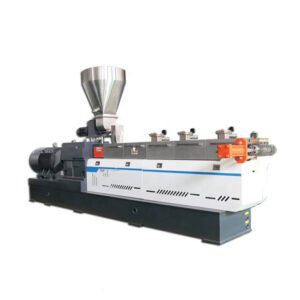
250-400kg/h Twin Screw Extruder For PP PE Film Pelletizing
The 250-400kg/h twin screw extruder for PP PE film pelletizing is designed for efficient recycling and granulation of plastic films. With advanced twin screw technology, the system ensures excellent mixing, stable plasticizing, and uniform pellet production. It is widely used in plastic film recycling plants and industrial pelletizing applications.
SKU: n/a -
Extrusion Equipment
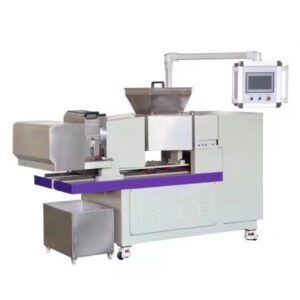
20-30kg/h Pelletizing Machine For PE PP PVC Plastic
The 20-30kg/h pelletizing machine for PE PP PVC plastic is designed for small-scale plastic recycling and granulation. It provides stable performance, efficient plasticizing, and uniform pellet production. The machine is suitable for laboratories, workshops, and small plastic processing plants.
SKU: n/a -
Extrusion Equipment
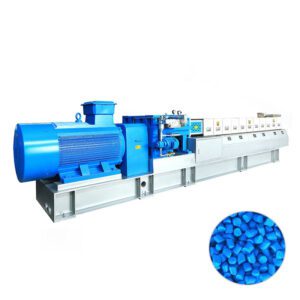
350-500kg/h Twin Screw Extruder For Color Masterbatch
The 350-500kg/h twin screw extruder for color masterbatch is designed for efficient compounding and production of high-quality color masterbatch. With advanced twin screw technology, the machine ensures excellent mixing, stable plasticizing, and consistent color dispersion. It is widely used in plastic compounding and masterbatch manufacturing industries.
SKU: n/a -
Extrusion Equipment
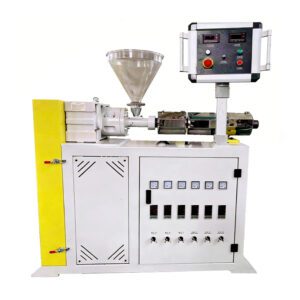
5-15kg/h Single Screw Extruder For PVC Processing
The 5-15kg/h single screw extruder for PVC processing is a compact plastic extrusion machine designed for small-scale production and laboratory applications. It offers stable performance, precise temperature control, and efficient plasticizing, making it ideal for processing PVC materials into profiles, pipes, and granules.
SKU: n/a