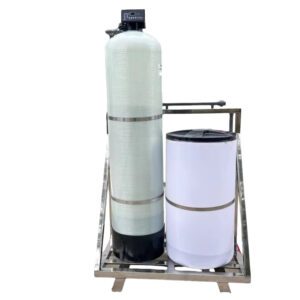
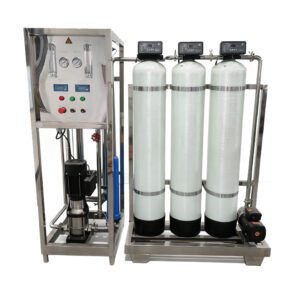
Industrial Water Softener Solution SS304 Duplex Resin Tank
The industrial water softener system is an ion exchange-based solution designed to remove hardness ions such as calcium and magnesium from raw water. Using strong acid cation resin, it replaces hardness ions with sodium ions to produce soft water with stable quality. Widely used in industrial, commercial, and municipal systems, it prevents scale formation, protects pipelines and equipment, and ensures efficient water system operation with low maintenance and high regeneration efficiency.
Compare
Industrial Water Softener Product Introduction
The industrial water softener system is an ion exchange-based hardness removal solution designed to eliminate calcium (Ca²⁺) and magnesium (Mg²⁺) from industrial and commercial water systems.
Using strong acid cation exchange resin (001×7), the system replaces hardness ions with sodium ions, producing stable soft water that prevents scaling, protects equipment, and improves system efficiency.
With automatic regeneration control and stable hydraulic performance, it is widely used in boilers, cooling systems, process water, and industrial manufacturing applications.
Water Hardness Problems
Hard water in industrial systems can cause:
- Scale formation in boilers and heat exchangers
- Reduced thermal efficiency and higher energy consumption
- Pipeline blockage and pressure loss
- Increased maintenance and downtime costs
- Poor cleaning performance in process systems
These issues are typically caused by excess calcium and magnesium ions in raw water.
Working principle
1. Ion Exchange Reaction Process
Hard water flows through resin bed containing sodium ions.
2. Calcium & Magnesium Removal
Ca²⁺ and Mg²⁺ are exchanged with Na⁺ ions on resin surface.
3. Soft Water Output
Treated water becomes low-hardness and scale-free.
4. Resin Saturation Stage
Resin gradually becomes exhausted after continuous operation.
5. Regeneration Cycle
Salt solution restores resin exchange capacity for reuse.
Chemical Reaction:
2RNa + Ca²⁺ → R₂Ca + 2Na⁺
2RNa + Mg²⁺ → R₂Mg + 2Na⁺
Product Parameter Table
| Water Output | 100 m³/hour |
| Resin Tank (Diameter × Height) | 1500×2500 mm × 1 PCS |
| Brine Tank | 2000 Liter × 2 PCS |
| Resin | 3200 kg |
| Resin Type | 001×7 strong acidic cation-exchange |
| Hardness of Raw Water | Less than 8 mmol/L |
| Hardness of Effluent | Less than 0.03 mmol/L |
| Inlet Water Pressure | 0.2 to 0.4 MPa |
| Free Chlorine | Less than 0.3 mg/L |
| Suspended Solid | Less than 0.5 mg/L |
| Iron Content | Less than 0.3 mg/L |
| Power Supply | 220 V/50 Hz |
| Control Mode | Flow rate type, time type |
| Working Ambient Temperature | 5-50 Centigrade |
| System Water Temperature | 5-45 Centigrade |
| Relative Humidity | Less than 95% (25 Centigrade) |
Water Softener vs Sand Filter System
| Feature | Water Softener | Sand Filter |
|---|---|---|
| Removes Hardness | Yes | No |
| Removes Suspended Solids | No | Yes |
| Application | Scale control | Particle filtration |
| Industrial Use | Boilers, cooling | Pre-filtration |
Water Softener vs RO System
| Feature | Water Softener | RO System |
|---|---|---|
| Hardness Removal | Excellent | Excellent |
| Energy Consumption | Low | High |
| Salt Removal | No | Yes |
| Operating Cost | Low | High |
Water Softener vs Chemical Dosing
| Feature | Ion Exchange System | Chemical Treatment |
|---|---|---|
| Automation | High | Medium |
| Stability | High | Medium |
| Environmental Impact | Low | Higher |
| Long-term Cost | Lower | Higher |
Conclusion: Ion exchange water softening is the most stable and cost-effective solution for industrial hardness removal.
Main Features
1. High Efficiency Hardness Removal
Removes calcium and magnesium ions with stable ion exchange performance.
2. Strong Acid Cation Resin (001×7)
High exchange capacity ensures long-term operational stability.
3. Automatic Regeneration System
Supports time-based and flow-based intelligent regeneration control.
4. Low Effluent Hardness (<0.03 mmol/L)
Ensures consistent soft water output for industrial systems.
5. Stable Industrial Operation Conditions
Works under 0.2–0.4 MPa pressure and 5–45°C temperature range.
6. Low Operating Cost Design
Minimizes salt consumption and maintenance requirements.
Application Scenarios
Boiler Feed Water Treatment
For scaling in boilers → improves heat transfer → reduces energy consumption
Cooling Water Systems
For heat exchanger fouling → improves thermal efficiency → reduces maintenance cost
Industrial Manufacturing Water
For unstable hardness levels → stabilizes production process → improves product quality
Food & Beverage Industry
For inconsistent water quality → ensures stable process water → improves safety compliance
FAQ
1. What is industrial water softener system used for?
It removes calcium and magnesium ions to prevent scaling in industrial water systems.
2. How does ion exchange water softener work?
It exchanges hardness ions with sodium ions using resin technology.
3. Does water softener remove iron?
It can remove small amounts of iron but is not a dedicated iron removal system.
4. How often should water softener regenerate?
Regeneration depends on water hardness level and system flow rate.
5. What is difference between hard water and soft water?
Hard water contains calcium and magnesium, soft water does not.
6. What industries use water softener systems?
It is widely used in boilers, cooling systems, manufacturing, and food industries.
Contact us to get your quotation now.
Get in touch with our engineering team.
Related products
-
Water Softening Systems
Compact Marine Water Softening And Filtration System For Small Boat
Compact marine water softening and filtration system designed for small boats and yachts. Removes hardness, sediment, and impurities while protecting onboard plumbing and equipment from scale and corrosion.
SKU: n/a -
Water Softening Systems
2000LPH Water Softening System for Villas Hotels Scale Control
This 2000LPH water softening system removes hardness ions through multi-stage treatment including resin softening, brine regeneration, and automatic valve control. It helps prevent scale in household appliances, pipelines, showers, and hotel water systems. Designed for whole-house and commercial use, it delivers stable soft water with reduced chlorine impact and improved water quality.
SKU: n/a -
Water Softening Systems
1-1.5T/H Domestic Water Softener for Home with WiFi Control
This 1–1.5T/H domestic water softener effectively removes hardness and impurities while retaining essential minerals. Suitable for whole-house water treatment, it features a fully automatic all-in-one design, integrated salt box, and WiFi control for convenient operation. Durable and hygienic components ensure long-term reliable performance. Ideal for residential use, this system delivers consistent softened water to kitchens, bathrooms, and appliances, protecting plumbing and improving water quality throughout the home.
SKU: n/a -
Water Softening Systems
1000 LPH Industrial Reverse Osmosis Water Treatment System
1000 LPH industrial reverse osmosis water treatment system designed for manufacturing, food processing, and pharmaceutical industries. Features multi-stage filtration, high-efficiency RO membranes, and stable industrial performance.
SKU: n/a