Industrial Vegetable Mesh Belt Dryer for Continuous Drying
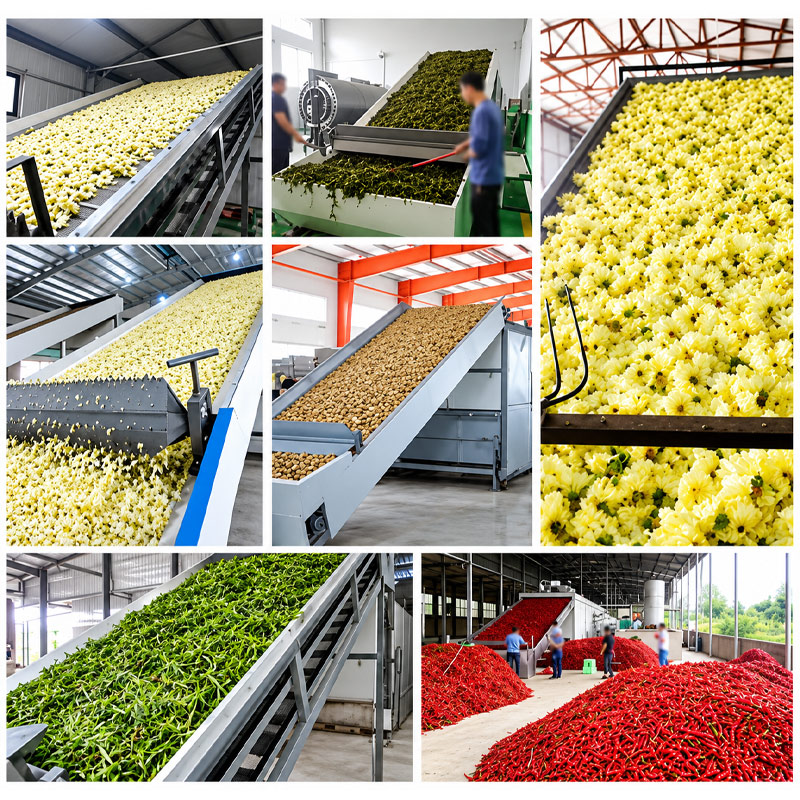
The Industrial Vegetable Mesh Belt Dryer is designed for continuous dehydration of vegetables, fruits, herbs, and other agricultural materials. Products are evenly distributed onto a moving mesh belt and continuously conveyed through the drying chamber, where circulating hot air removes moisture. With multi-layer belt configurations, adjustable processing conditions, and multiple heat source options, the system is suitable for medium- to large-scale continuous food drying applications.
Compare
Vegetable Mesh Belt Dryer Product Introduction
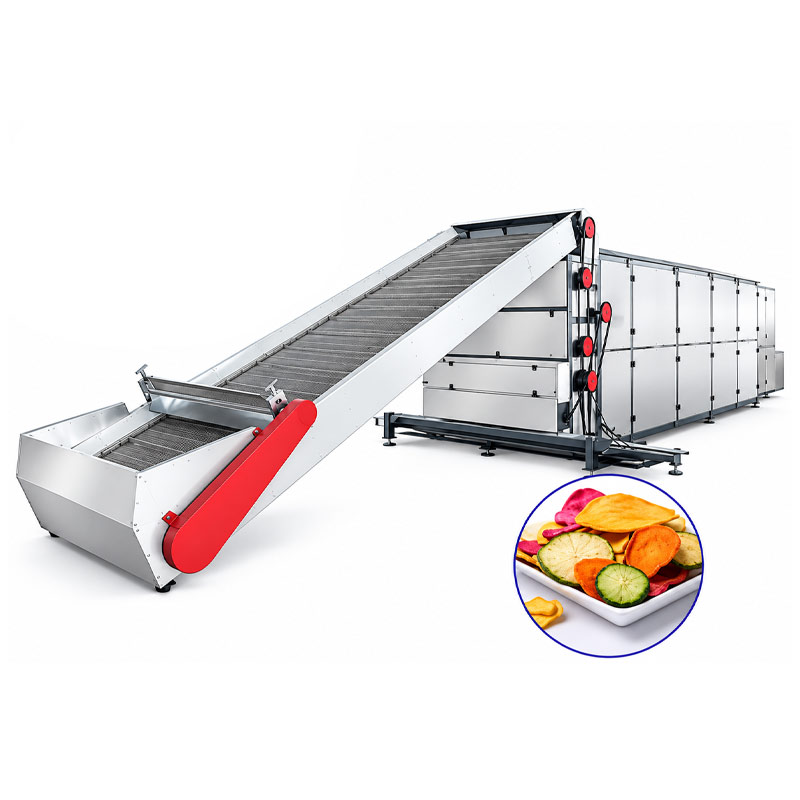
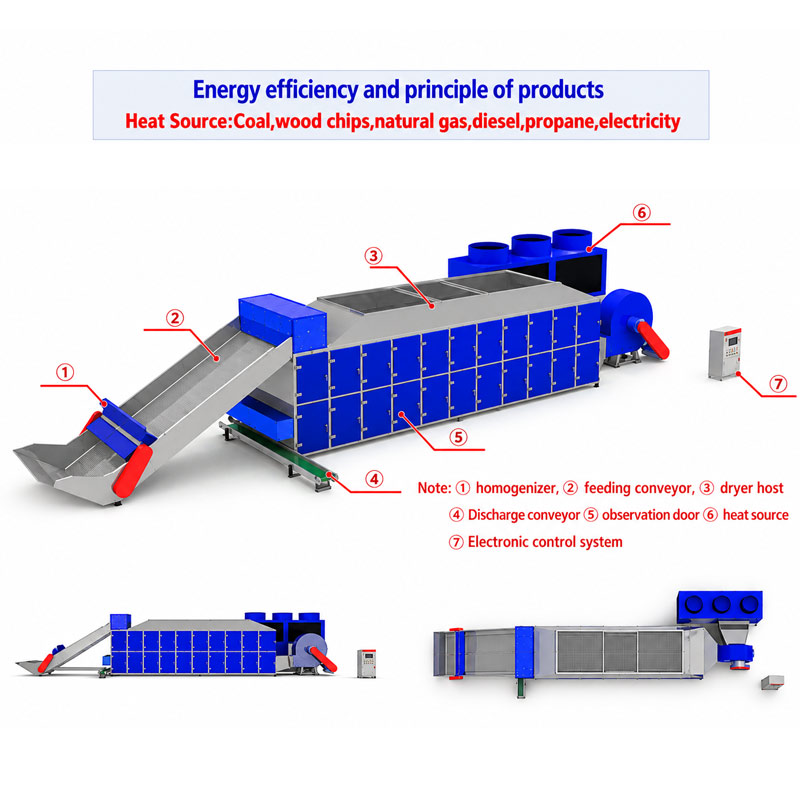
The Industrial Vegetable Mesh Belt Dryer for Continuous Drying is a continuous drying system developed for large-scale dehydration of vegetables and other suitable food and agricultural materials.During operation, prepared material is continuously fed onto the mesh conveyor and distributed across the belt. The conveyor transports the product through the drying chamber while heated air circulates through and around the material layers. Moisture released from the product is carried away by the airflow, allowing continuous feeding, drying, and discharge.
The reference equipment operates within a temperature range of 40–120°C, with a stated drying time of approximately 0.5–5 hours, depending on the material and process conditions. The overall product range is stated as suitable for outputs of approximately 200–3000 kg/h. Unlike batch drying chambers, the mesh belt design supports continuous production, making it particularly suitable for processing facilities requiring regular and relatively high-volume vegetable dehydration.
How Does a Vegetable Mesh Belt Dryer Work?
The operating principle is based on continuous conveying combined with forced hot-air drying.Prepared vegetables are introduced through the feeding system and distributed onto the mesh belt. As the belt moves through the enclosed drying chamber, heated air contacts the product and removes moisture.In a multi-layer configuration, material travels through successive belt levels before reaching the discharge section. This arrangement increases the effective drying area while keeping the equipment relatively compact.The reference manufacturer describes electric heating, steam heating and hot-air heating as principal heating methods and specifies a working range of 40–120°C.
Main Components of the Continuous Mesh Belt Dryer
A complete continuous vegetable drying system can incorporate feeding, drying, heating, air circulation, exhaust, discharge, and electrical control sections.The reference manufacturer’s related technical description identifies components including the homogenizer/material distributor, feeding conveyor, dryer host, output conveyor, observation doors, heat source, air intake system, and control panel.
Feeding Conveyor
The feeding conveyor continuously transfers prepared vegetables into the dryer.It can be integrated with upstream washing, cutting, blanching, or other processing equipment depending on the complete production line.
Material Distribution System
The material distributor helps spread incoming products across the working width of the conveyor.More consistent loading helps avoid excessive accumulation in individual areas of the belt.
Multi-Layer Mesh Belt
The mesh belt carries the product through the drying chamber.
Depending on the selected configuration, the reference equipment can be designed with 4, 5, or 6 drying layers, providing different total drying areas.
Drying Chamber
The enclosed dryer host provides the main working area for continuous dehydration.The reference manufacturer states that the dryer can be constructed using stainless steel or painted materials depending on configuration.
Hot Air Circulation System
Fans move heated air through the drying chamber and around the product.Proper airflow is important because drying performance depends not only on temperature but also on air distribution, material thickness, loading condition, and product characteristics.
Moisture Exhaust System
As water evaporates from the vegetables, moisture-laden air must be removed from the drying chamber.The reference configurations therefore include an exhaust fan as part of the drying system.
Discharge Conveyor
After completing the drying cycle, the material is continuously discharged for subsequent cooling, inspection, conveying, or packaging.
Multi-Layer Continuous Drying Design
One of the main characteristics of this equipment is its multi-layer mesh belt structure.Instead of relying on a single long conveyor, multiple belt levels provide a larger effective drying surface inside the equipment.The reference range provides 4-layer, 5-layer and 6-layer configurations. Depending on dryer length and number of layers, the published drying area ranges from 36 m² to 180 m². This structure is particularly suitable for continuous processing of materials that can be distributed across a mesh conveyor.
Technical Specifications
| Specification | 2×6m | 2×8m | 2×9m | 2×10m | 2×12m | 2×15m |
|---|---|---|---|---|---|---|
| 4-Layer Drying Area | 36 m² | 64 m² | 72 m² | 80 m² | 96 m² | 120 m² |
| 5-Layer Drying Area | 45 m² | 80 m² | 90 m² | 100 m² | 120 m² | 150 m² |
| 6-Layer Drying Area | 54 m² | 96 m² | 108 m² | 120 m² | 144 m² | 180 m² |
| Material Thickness | 50–200 mm | 50–200 mm | 50–200 mm | 50–200 mm | 50–200 mm | 50–200 mm |
| Operating Temperature | 40–120°C | 40–120°C | 40–120°C | 40–120°C | 40–120°C | 40–120°C |
| Drying Time | 0.5–5 h | 0.5–5 h | 0.5–5 h | 0.5–5 h | 0.5–5 h | 0.5–5 h |
| Conveyor Motor | 1.1 kW | 1.5 kW | 1.5 kW | 2.2 kW | 3 kW | 5.5 kW |
| Evaporation Capacity | 300–500 kg/h | 430–550 kg/h | 500–600 kg/h | 560–650 kg/h | 620–750 kg/h | 1000–1200 kg/h |
| Main Fan | 8C–11 kW | 10C–15 kW | 10C–15 kW | 11C–22 kW | 12C–22 kW | 14C–55 kW |
| Output Conveyor | 0.12 kW | 0.12 kW | 0.12 kW | 0.12 kW | 0.12 kW | 0.12 kW |
| Total Power | 14.9 kW | 20.7 kW | 24.2 kW | 28.4 kW | 37.2 kW | 64.7 kW |
Key Features
- Continuous Automatic Drying
Material can move continuously from feeding through drying to discharge, making the system suitable for industrial production. - Multi-Layer Belt Configuration
Four-, five-, and six-layer arrangements are available in the reference series, allowing different effective drying areas within the equipment footprint. - Large Drying Area
Depending on model and belt configuration, the published drying area extends from 36 m² up to 180 m². - Adjustable Processing Conditions
Drying temperature and material residence time can be selected according to product requirements and equipment configuration. - Multiple Heating Options
Different available heat sources allow the system to be adapted to local utilities and production conditions. - Continuous Feeding and Discharge
The conveyor arrangement supports integration with upstream preparation equipment and downstream cooling or packaging equipment. - Wide Material Compatibility
The reference manufacturer positions the equipment for vegetables, fruits, food products, pharmaceutical materials, and agricultural products.
Advantages of Continuous Mesh Belt Drying
For medium- and large-scale vegetable dehydration, a continuous belt dryer provides a different production approach from a batch drying chamber.Products can enter the dryer continuously rather than requiring complete chamber loading and unloading between every batch. Multi-layer conveying also provides a relatively large drying area within one integrated system.
How to Select the Right Vegetable Mesh Belt Dryer
The reference range provides several dryer lengths and multiple belt-layer configurations, so machine selection should be based on the actual process rather than equipment length alone.
Before determining a suitable configuration, the following information should be confirmed:
- Raw Material: What vegetables or other materials will be dried?
- Input Capacity: Required kg/h of fresh material
- Initial Moisture: Moisture content before drying, if available
- Target Moisture: Required final moisture content
- Product Size: Whole, sliced, diced, shredded, leaf, etc.
- Material Thickness: Approximate loading depth on the belt
- Heat Source: Electricity, steam, gas, biomass or other available source
- Operating Hours: Required hours per day
- Power Supply: Voltage / phase / frequency
- Installation Space: Available length, width and height
FAQ
What is an industrial vegetable mesh belt dryer?
It is continuous drying equipment that conveys vegetables through an enclosed drying chamber on mesh belts while heated air removes moisture from the material.
Is this a batch or continuous dryer?
It is designed for continuous production. Material enters through the feeding section, moves through the dryer on the mesh belt, and exits through the discharge section.
What is the drying temperature?
The reference equipment specifies an operating range of 40–120°C.
How long does vegetable drying take?
The manufacturer gives a reference range of 0.5–5 hours. Actual residence time depends on vegetable type, dimensions, moisture content, target moisture, loading depth, temperature and airflow.
What capacity is available?
The product page gives a general output range of 200–3000 kg/h. Individual models also specify evaporation capacities from approximately 300–500 kg/h up to 1000–1200 kg/h. These figures describe different parameters and should not be treated as directly interchangeable.
How many mesh belt layers are available?
The published technical configurations provide 4, 5 and 6 layers.
What heat sources can be used?
The reference page lists coal, wood chips, natural gas, diesel, propane and electricity, while its working-principle description also refers to electric, steam and hot-air heating. The final heating configuration should be confirmed for each project.
Can the dryer process products other than vegetables?
Yes. The reference equipment is positioned for food, fruits, pharmaceutical materials, and other agricultural products in addition to vegetables.
Can the dryer be connected to a complete processing line?
Yes. Its continuous feeding and discharge arrangement makes it suitable for integration with appropriate upstream preparation and downstream handling equipment.
Contact us to get your quotation now.
Get in touch with our engineering team.
Related products
-
Central Kitchen Food Processing Machines
Central Kitchen Food Processing Frozen Meat Slicer
This Central Kitchen Food Processing Frozen Meat Slicer is specifically engineered for high-efficiency, large-volume meat pre-processing. As a core component of central kitchen food processing machines, it can quickly and precisely slice frozen meat rolls or blocks at sub-zero temperatures, eliminating the need for pre-thawing and significantly boosting preparation speed and food safety. The slicer features adjustable slicing thickness and a powerful drive system, ensuring every slice is of uniform thickness and has clean edges. Its full stainless steel construction and easy-to-disassemble design make daily cleaning and maintenance simple and efficient, making it the ideal choice for chain restaurants, canteens, and meat processing plants.
SKU: n/a -
Central Kitchen Food Processing Machines
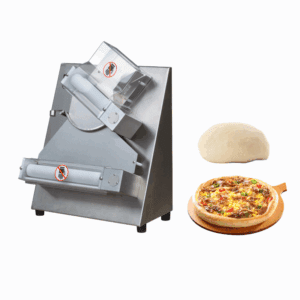
0.37kw Pizza Dough Forming Machine With Adjustable Thickness
 Central Kitchen Food Processing Machines
0.37kw Pizza Dough Forming Machine With Adjustable Thickness
The pizza dough forming machine is equipped with an automatic flour sprinkling device, which can evenly spread flour to prevent sticking. After the dough is formed, the edges are neat, the surface is smooth, and the thickness is uniform.
SKU: n/a -
Central Kitchen Food Processing Machines
1000pcs/h Automatic Wonton Machine for Mass Production
The fully automatic wonton machine features a synchronized feeding system that precisely coordinates the delivery of wrappers and filling. The wrapper-to-filling ratio can be adjusted as needed, ensuring each wonton is plump and evenly filled. With a stable output of up to 1000 pieces per hour, it is 4-6 times more efficient than manual wrapping, significantly reducing labor costs.
SKU: n/a -
Central Kitchen Food Processing Machines
Central Kitchen Food Processing Machines High-Efficiency Deep Fryer for Restaurants
Central Kitchen Food Processing MachinesCentral Kitchen Food Processing Machines High-Efficiency Deep Fryer for Restaurants
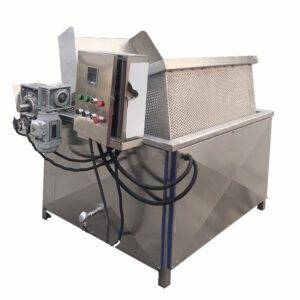
Our Central Kitchen Food Processing Deep Fryer is a critical piece of equipment designed specifically for chain restaurants and large-scale catering services. It integrates a high-volume frying function, capable of continuously and efficiently handling large quantities of ingredients, perfectly suited for the peak demands of fast food or pre-made meal production. Technically, this deep fryer utilizes an advanced PID precise temperature control system, ensuring oil temperature fluctuations are managed within , guaranteeing the consistent texture and golden color of every fried batch. Furthermore, the integrated automatic oil filtration and replenishment systemsignificantly extends the lifespan of the cooking oil while enhancing food safety and operational efficiency by reducing manual handling.
SKU: n/a