Industrial 20 BBL Fermentation Tank System Stainless Steel
The 20 BBL fermentation tank system is a high-performance stainless steel brewing vessel designed for industrial beverage production. It supports beer, wine, yoghurt, and vinegar fermentation with precise temperature control, hygienic structure, and durable SUS304/SUS316 construction. Equipped with advanced cooling jackets, PLC control options, and customizable finishing, it ensures stable fermentation performance, improved yeast management, and efficient production output for commercial breweries and food processing plants.
Compare
Product introduction of Fermentation Tank System
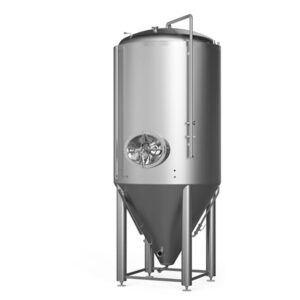
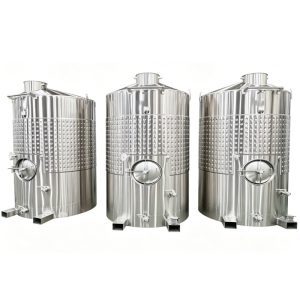
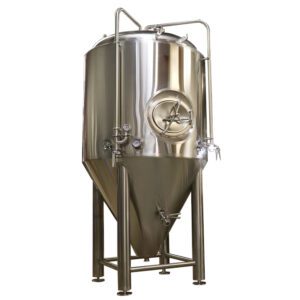
The fermentation tank system 20 BBL is engineered for large-scale brewing operations requiring consistency, hygiene, and production efficiency. Its conical structure supports efficient yeast separation, while the dimple jacket cooling system ensures stable fermentation temperature control. Designed for multi-industry use, it delivers reliable performance for breweries, dairy processing, and vinegar production facilities.
Working principle
Step 1: Filling and sealing
The tank is filled with raw material and sealed to maintain a clean fermentation environment.
Step 2: Temperature control
Glycol flows through the dimple jacket to keep stable fermentation temperature.
Step 3: Fermentation process
Yeast converts sugars into alcohol and CO₂ under controlled pressure.
Step 4: Sediment separation
Solids settle in the conical bottom for easy discharge.
Step 5: Discharge and cleaning
Finished product is removed, then the tank is prepared for CIP cleaning.
Product Parameter Table
| Parameter | Specification |
|---|---|
| Effective volume | 20 BBL |
| Total volume | 25 BBL |
| Size | 1700 × 3350 mm |
| Material | SUS304 / SUS316 |
| Control system | PLC Siemens or PID Schneider / ABB brand |
| Work pressure | Inner jacket: 0.4 MPa; Cooling jacket: 0.5 MPa |
| Design pressure | Inner jacket: 0.2 MPa; Cooling jacket: 0.3 MPa |
Comparison: Standard Tank vs 20 BBL System
| Feature | Standard Fermenter | 20 BBL System |
|---|---|---|
| Capacity | Low to medium batch | Industrial high-volume production |
| Temperature Control | Basic cooling | Dimple jacket precision cooling |
| Material | SS201/SS304 | SUS304/SUS316 food grade |
| Yeast Removal | Manual discharge | Conical automatic sediment removal |
| Automation | Limited control | PLC/PID smart control system |
| Cleaning Efficiency | Standard access | Shadowless manway design |
Main Features
- SUS304/SUS316 stainless steel construction for food-grade safety performance
- 60-degree conical bottom for efficient yeast sediment discharge system
- Dimple cooling jacket ensures stable fermentation temperature control
- Rotating racking arm for flexible beer and liquid transfer operation
- PLC or PID control system for precise automated fermentation management
- Pressure-tested inner and cooling jackets ensure operational safety reliability
- Mirror, brushed, or pickled surface finishing options available customization
- Shadowless manway design improves cleaning efficiency and access safety
- Adjustable leveling bolts ensure stable installation on industrial floors
- Extra headspace design improves fermentation gas expansion stability
Application Scenarios
- For unstable beer fermentation temperature control → dimple jacket system → ensures consistent fermentation quality output
- For yeast sediment accumulation issues → 60-degree conical bottom design → improves yeast discharge efficiency
- For contamination risk in beverage production → sealed stainless steel structure → enhances hygienic safety standards
- For inefficient production scaling in breweries → 200BBL large capacity design → increases batch production volume
- For difficult cleaning in industrial tanks → shadowless manway access → reduces downtime and improves sanitation
- For inconsistent liquid transfer during brewing → rotating racking arm system → enables smooth and flexible discharge
Why Choose This Fermentation Tank System
- High-capacity 20 BBL design supports industrial-scale production efficiency
- Advanced temperature control improves fermentation stability and product consistency
- Hygienic stainless steel construction meets global food-grade standards
- Flexible customization supports beer, wine, yoghurt, and vinegar production
- Multi-pressure testing ensures long-term operational safety and reliability
- Automation-ready system reduces manual operation cost and labor dependency
- Strong structural design extends equipment service life in industrial environments
FAQ
What is a 20 BBL fermentation tank system used for?
It is used for small to medium-scale beer and beverage fermentation production.
How does a stainless steel fermentation tank control temperature?
It uses a glycol dimple jacket system for precise cooling and heating regulation.
Why is a conical fermentation tank important in brewing systems?
It allows efficient yeast sediment separation and improves product clarity.
Can a 20 BBL fermenter be used for wine and yoghurt production?
Yes, it supports beer, wine, yoghurt, and vinegar fermentation processes.
What is the working pressure of a fermentation tank system?
Typically inner jacket 0.4 MPa and cooling jacket 0.5 MPa.
How is yeast removed in a conical fermentation system?
Yeast naturally settles at the bottom and is discharged via racking arm.
Is the fermentation tank system easy to clean?
Yes, it supports CIP cleaning for efficient sanitation and maintenance.
What material is used in industrial fermentation tanks?
SUS304 or SUS316 stainless steel is used for food-grade safety.
What is the advantage of glycol cooling in fermentation tanks?
It ensures stable temperature control for consistent fermentation results.
What industries use 20 BBL fermentation systems?
Craft breweries, wineries, dairy production, and vinegar manufacturing.
Contact us to get your quotation now.
Get in touch with our engineering team.
Related products
-
Beer Fermentation & Brite Tank
30 BBL Conical Jacketed Fermenter for Craft Beer Brewing
Fermenter is also called CCT (Cylindrical Conical Tank), FV (Fermentation Vessel), primary fermentor or unitank as they are used both for fermenting and lagering. Fermenting is the process during which the yeast transforms the wort into beer. Lagerings takes place after fermenting and is the time given to the beer to stabilize and age after fermenting.
SKU: n/a -
Beer Fermentation & Brite Tank
2000L Beer Fermentation Tank Stainless Steel Manufacturer
2000L beer fermentation tank made of food-grade stainless steel, designed for efficient and hygienic beer production. This system ensures precise temperature control, stable fermentation performance, and consistent beer quality. With a conical bottom design for easy yeast removal and a durable structure for long-term use, it is ideal for craft breweries, microbreweries, and commercial beer production facilities seeking reliable and scalable fermentation solutions.
SKU: n/a -
Beer Fermentation & Brite Tank
60 BBL Conical Jacketed Fermenter Vertical beer fermentation tanks Unitanks
 Beer Fermentation & Brite Tank
60 BBL Conical Jacketed Fermenter Vertical beer fermentation tanks Unitanks
• Interior/Exterior Tig welded 304 Stainless Steel
• 3mm interior tank wall thickness
• 2mm exterior shell wall thickness
• 3″ polyurethane insulation on shell and cone (chloride free)
• 2B sanitary interior polish (pickled and passivated)
• 4N exterior polish (sanitary) • Adjustable feet with anchor holes
SKU: n/a -
Beer Fermentation & Brite Tank
2000 Liter Beer Fermentation Vessels/Fermenters/Unitanks
2000L Beer Fermentation Tank is made of stainless steel. You may also heard some other names as conical fermenter, fermentation vessels, Unitank, or even FV, is the key part to hold wort after brewing and turns it into beers in days.
Side Manway Conical Fermenter, is built for those industrial breweries who will ferment beers with volume from 500L to 5,000L.
With the Standard fully polished 304 stainless steel material, it has all standard sanitary welded tri-clamp fittings and CIP arm. There are also some more advanced add-on features, pick up the one which suitable for your current stage.
SKU: n/a