 Heavy-Duty Cutting Tool Holder for CNC Milling High Clamping
 Subtotal: $98.00


Industrial Water Treatment Equipment
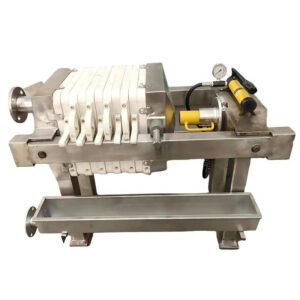
2400 L Filter Press For Gravel Wastewater Slurry Separation
The 2400 L filter press is a batch-operated solid-liquid separation system designed for industrial slurry dewatering. It works by pumping slurry into chamber plates where solids accumulate on filter cloths to form a compact filter cake. The system is widely applied in mining, ceramics, stone processing, and chemical wastewater treatment. It provides controlled filtration pressure, stable cake formation, and efficient filtrate discharge through manifold channels for downstream water reuse or safe disposal.
Compare
Product introduction of 2400 L Filter Press
The 2400 L filter press is an industrial dewatering machine designed for separating suspended solids from liquid in slurry-based wastewater. It consists of multiple chamber plates and filter cloths that operate under hydraulic pressure to form dense filter cakes. The equipment is suitable for handling high-solid-content wastewater generated from mining, stone processing, ceramics, and chemical industries. It helps reduce sludge volume and improve water recovery efficiency. The system is built for stable operation under demanding conditions, supporting continuous industrial filtration requirements with consistent performance and controlled process handling.
Working principle
Slurry is pumped into the filter press and distributed into chamber plates. Solid particles are retained by filter cloths while liquid passes through as filtrate. Gradually, solids accumulate and form a filter cake that acts as a depth filtration layer. As pressure increases, chambers become fully filled with cake. Filtrate exits through corner ports and manifold channels. After the cycle is complete, the press is opened and the dewatered cake is discharged for further handling.
Product Parameter Table
| Parameter | Value |
| Filter area | 120 m² |
| Plate size | 1250×1250 mm |
| Chambers No. | 46 |
| Total volume | 2400 L |
| Working pressure | ≤0.8 MPa |
| Press pressure | ≤1.2 MPa |
| External Dimensions (L×W×H) | 6060×1620×2050 mm |
| Machine weight | 8900 kg |
Main Features
- Chamber plate filtration structure allows uniform slurry distribution and stable filter cake formation across all filtration cycles.
- Hydraulic pressure system ensures controlled compression force for efficient solid liquid separation under variable feed conditions.
- High capture efficiency filter cloth design improves particle retention and reduces solid leakage during filtration process.
- Modular frame construction enables flexible maintenance access and adaptation for different industrial process requirements.
- Robust mechanical structure supports long operating cycles in mining, stone, and chemical wastewater environments.
- Closed filtration system reduces environmental exposure and supports safe handling of aggressive industrial slurry media.
Application Scenarios
- Mining and mineral processing wastewater sludge dewatering
- Stone cutting, granite, and marble slurry treatment systems
- Ceramic production wastewater solid liquid separation processes
- Coal washing and sand washing plant sludge management
- Chemical, pharmaceutical, and electroplating wastewater treatment
- Textile dyeing and leather industry effluent filtration systems
Contact us to get your quotation now.
Get in touch with our engineering team.
Related products
-
Industrial Centrifuge
1200 RPM Bag Lifting Centrifuge For Chemical Separation Use
The bag lifting centrifuge is a high-efficiency solid-liquid separation system designed for batch processing and hygienic discharge operations. It uses frequency conversion speed control and PLC automation to ensure stable and programmable operation. The machine enables vibration-free installation without foundation and supports clean, contamination-free handling. It is widely used in industries requiring high cleanliness and controlled separation, providing efficient dewatering, filtration, and manual or assisted discharge under safe operating conditions.
SKU: n/a -
Plate and Frame Filter Press
Small Manual Lab Filter Press for Solid and Liquid Separation
The manual hydraulic filter press is ideal for small-scale experiments, compact sewage tanks, and small food factories. It offers simple operation, a small footprint, and reliable durability, ensuring efficient solid-liquid separation. Low maintenance requirements make it easy to operate and cost-effective. Perfect for laboratory and small industrial applications, this compact filter press delivers precise filtration, high efficiency, and long-lasting performance in various chemical, food, and wastewater treatment processes.
SKU: n/a -
Industrial Centrifuge
3-15 t/h Screen Centrifuge For Salt Solid Liquid Separation
The 3–15 t/h screen centrifuge is a continuous solid-liquid separation machine designed for dewatering crystalline and granular materials with high concentration and poor fluidity. It uses a screw feeding system to improve stability and reduce vibration during operation. The equipment provides efficient dewatering performance under high load conditions. It is suitable for industrial processes requiring stable handling of difficult-to-flow materials, ensuring consistent separation results in mineral, chemical, and salt-related production environments.
SKU: n/a -
Industrial Centrifuge
3–15 m³/h Decanter Centrifuge For Peanut Protein Separation
The decanter centrifuge is a continuous solid liquid separation machine designed for processing industrial suspensions with fine and medium particles. It operates through high speed rotation and differential screw conveyance, enabling efficient separation, sludge dewatering, and liquid clarification. This equipment is widely used in chemical, food, pharmaceutical, and environmental industries. It ensures stable operation, high capacity processing, and consistent separation performance for various slurry and suspension materials in continuous production systems.
SKU: n/a