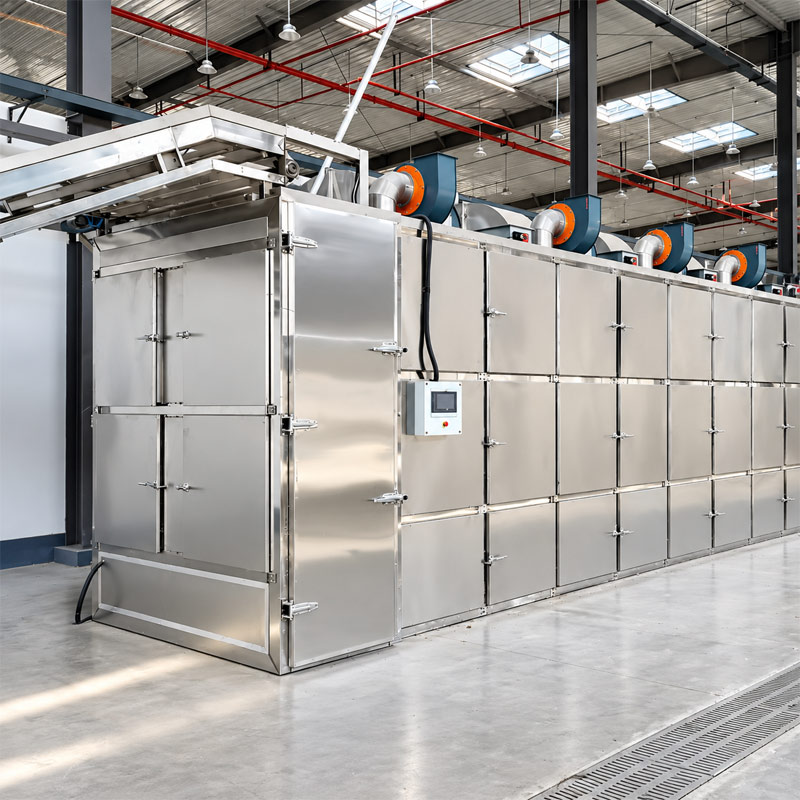
Industrial Multi-Layer Mesh Belt Dryer for Food Processing
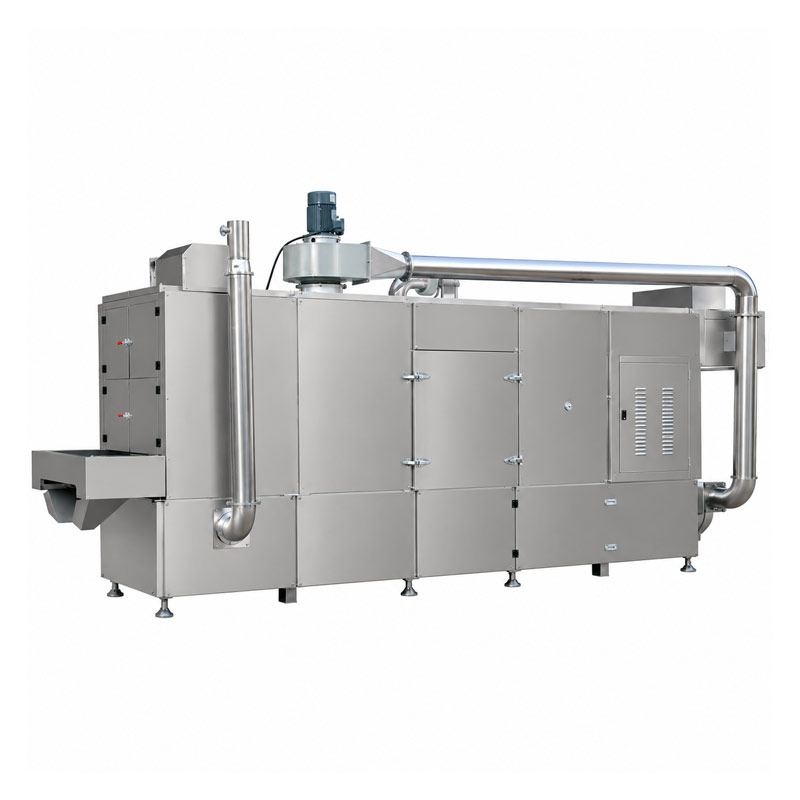
The industrial multi-layer mesh belt dryer is designed for continuous drying of food ingredients and agricultural materials. Its moving mesh belt carries products through a heated chamber, while circulating hot air supports moisture removal across the material layer. Multiple belt widths and drying lengths provide flexible production options for different throughput requirements. The system is suitable for granules, slices, and other materials that can be spread evenly on the belt, with operating conditions selected according to product characteristics.
Compare
Multi-Layer Mesh Belt Dryer Product Description
The industrial multi-layer mesh belt dryer is designed for continuous drying of food ingredients and selected agricultural materials. Products are spread across a moving mesh belt and pass through a heated chamber, where circulating hot air helps remove moisture. Its multi-layer conveying path supports continuous processing within a compact equipment layout.Available configurations vary in belt width and drying length to match different production requirements. Reference specifications include belt widths of 1.2, 1.6, and 2 meters, drying lengths of 8 or 10 meters, and an operating temperature range of 50–120°C. The recommended material layer thickness is 10–50 mm.
The dryer can handle suitable granules, slices, and sheet-like materials in food and related industries. Actual drying results depend on material type, initial moisture content, target moisture level, loading density, and airflow conditions. Confirm evaporation rate, utility requirements, and the appropriate configuration for your product before ordering.
Main Features
1. Multi-Layer Mesh Belt Design
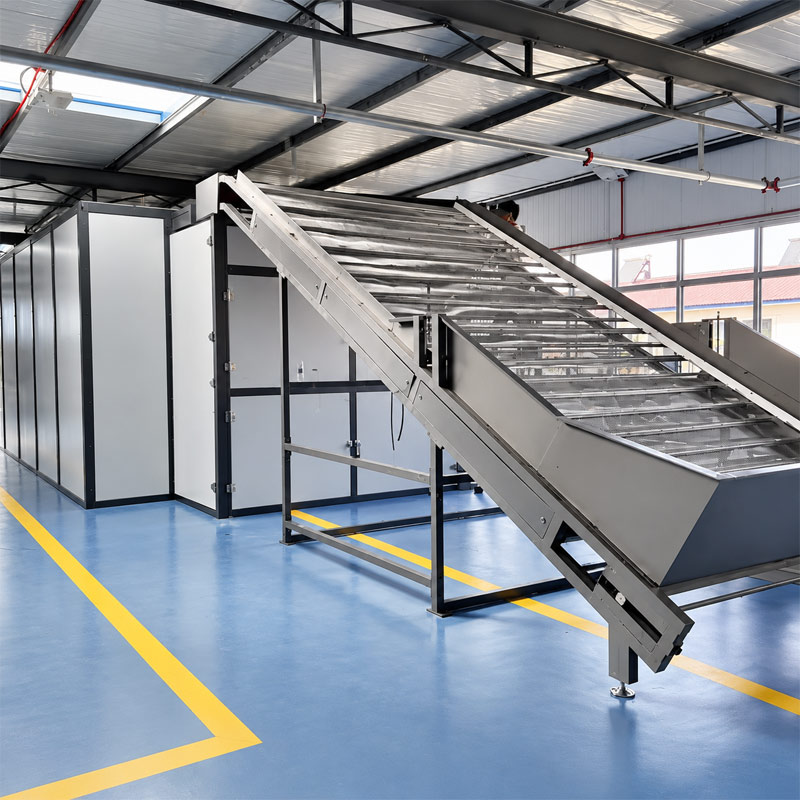
The multi-layer conveying arrangement allows materials to move through different drying sections, helping make effective use of the available equipment footprint while supporting continuous production.
2. Continuous Drying Operation
The moving mesh belt transports materials through the drying chamber at a controlled rate. Belt speed and operating conditions can be selected according to the material and required drying result.
3. Hot Air Circulation System
Circulating hot air transfers heat to the materials and helps remove moisture during the drying process. Appropriate airflow and loading conditions support more consistent drying across the product layer.
4. Adjustable Temperature Control
The reference equipment specifies a temperature range of 50–120°C. Operating conditions can be selected according to material characteristics, moisture content, and product quality requirements.
5. Flexible Belt Width and Drying Length
Multiple configurations are available with mesh belt widths of 1.2, 1.6, or 2 meters and drying lengths of 8 or 10 meters. These options help accommodate different production requirements.
6. Intelligent Process Control
A control system can be used to manage operating parameters such as temperature and humidity, depending on the selected configuration. This supports more controlled and repeatable drying operations.
7. Wide Material Compatibility
The dryer is suitable for compatible granular, sliced, and sheet-like materials used in food processing and selected agricultural, chemical, and related industrial applications.
Technical Specifications
| Parameter | Configuration A | Configuration B | Configuration C | Configuration D | Configuration E | Configuration F |
|---|---|---|---|---|---|---|
| Mesh belt width | 1.2 m | 1.2 m | 1.6 m | 1.6 m | 2 m | 2 m |
| Drying length | 8 m | 10 m | 8 m | 10 m | 8 m | 10 m |
| Material layer thickness | 10–50 mm | 10–50 mm | 10–50 mm | 10–50 mm | 10–50 mm | 10–50 mm |
| Operating temperature | 50–120°C | 50–120°C | 50–120°C | 50–120°C | 50–120°C | 50–120°C |
| Water evaporation rate | 80–220 kg/h | 100–320 kg/h | 90–300 kg/h | 120–380 kg/h | 130–400 kg/h | 180–500 kg/h |
| Total installed power | 21.2 kW | 21.2 kW | 21.2 kW | 22.7 kW | 22.7 kW | 22.7 kW |
| Total weight | 3,000 kg | 4,000 kg | 4,400 kg | 4,550 kg | 4,300 kg |
Additional Specifications
- Steam consumption: ≤ 2 kg of steam per kg of water evaporated
- Reference vapor pressure: 0.2–0.5 MPa
- Overall dimensions: Customizable according to configuration
- Drying method: Continuous mesh belt drying with circulating hot air
- Material feeding: Continuous belt feeding
- Application: Food ingredients and selected agricultural materials
Working Principle
The multi-layer mesh belt dryer operates by conveying materials through a heated drying chamber on a moving mesh belt. Wet materials are distributed across the belt in a suitable layer thickness and transported through the drying sections.Heated air circulates around the materials, transferring heat and promoting moisture evaporation. As the material moves through the dryer, moisture is gradually removed under controlled operating conditions. The dried product is discharged at the end of the conveying path for cooling, storage, or subsequent processing.
The drying temperature, belt speed, airflow, and loading thickness should be adjusted according to the product’s initial moisture content and target drying level. Proper parameter selection helps achieve the required drying result while maintaining suitable product quality.
Why Choose This Industrial Mesh Belt Dryer?
Selecting the right drying equipment is important for achieving consistent product quality and meeting production targets. This industrial multi-layer mesh belt dryer combines continuous conveying, circulating hot air, and configurable belt dimensions in one integrated drying system.Its range of belt widths and drying lengths provides flexibility for different processing requirements. The system can be considered for fruit and vegetable dehydration, mushroom drying, herb processing, and other compatible applications that require continuous moisture removal.
Before choosing a configuration, evaluate the material type, initial moisture content, target moisture level, required throughput, available installation space, and utility conditions. These details help determine the appropriate belt dimensions, operating temperature, and drying time for the intended process.
 FAQ
Q1. What materials can a multi-layer mesh belt dryer process?
It can process suitable fruits, vegetables, mushrooms, herbs, spices, and selected granular or sheet-like materials. Compatibility depends on material size, moisture content, belt design, and required drying conditions.
Q2. What is the operating temperature range?
The reference specifications list an operating temperature range of 50–120°C. The appropriate setting depends on the material and the desired final moisture content.
Q3. What mesh belt widths are available?
The reference configurations include belt widths of 1.2 m, 1.6 m, and 2 m, with drying lengths of 8 m or 10 m.
Q4. What is the water evaporation capacity?
The listed water evaporation rates range from 80 to 500 kg/h, depending on the configuration. This figure represents water removal rather than finished product throughput.
Q5. How do I determine the required drying capacity?
Consider the amount of material entering the dryer per hour, initial moisture content, target moisture level, material thickness, and available processing time. A drying test or engineering assessment can help determine the appropriate configuration.
Q6. What utilities does the dryer require?
The reference specifications list steam consumption and a vapor pressure range of 0.2–0.5 MPa. Confirm the required steam supply, electrical power, and other utility requirements for the selected configuration.
Q7. Can the equipment dimensions be customized?
Yes. The reference page indicates that overall dimensions can be customized. Confirm the available options based on the required capacity, factory layout, and material-handling requirements.
Contact us to get your quotation now.
Get in touch with our engineering team.
Related products
-
Central Kitchen Food Processing Machines
1.6KW Automatic Fermenter with Constant Temperature Proofing
Central Kitchen Food Processing Machines1.6KW Automatic Fermenter with Constant Temperature Proofing
The Automatic Fermenter with Constant Temperature Proofing can support one-touch setting of fermentation time, temperature, and humidity parameters. It also features timed reminders, fault alarms, and other functions. This device operates without the need for manual supervision, enabling full-process fermentation automation. It is a key piece of equipment for enhancing the standardization and scalability of bakery production, helping businesses reduce labor costs and stabilize product quality.
SKU: n/a -
Central Kitchen Food Processing Machines
Central Kitchen Food Processing Machines Intelligent Automatic Cooker
Central Kitchen Food Processing MachinesCentral Kitchen Food Processing Machines Intelligent Automatic Cooker
Our Intelligent Automatic Cooker is a revolutionary piece of equipment in the modern central kitchen food processing workflow, specifically designed for chain restaurants and large canteens. Its core function is one-touch, high-quality cooking, particularly excelling at preparing fried rice, stir-fries, and pasta, guaranteeing a high degree of flavor consistency for every dish. Technically, the unit is equipped with an advanced sensor feedback system, paired with precise automatic heat regulation and 360-degree simulated manual stirring technology, effectively preventing sticking and accurately replicating a professional chef’s technique, significantly boosting serving efficiency and dish standardization.
SKU: n/a -
Central Kitchen Food Processing Machines
Multifunctional Cooking & Processing Pot for Condiments Used in Canteen and Central Kitchen Operations
Central Kitchen Food Processing MachinesMultifunctional Cooking & Processing Pot for Condiments Used in Canteen and Central Kitchen Operations
Selling Points of Multifunctional Cooking & Processing Pot
- Industrial – Grade Quality Assurance
Constructed from stainless steel, the jacketed kettle offers exceptional durability and corrosion resistance. Meeting strict food – processing hygiene standards, it endures high – intensity, long – term industrial use, ensuring an extended lifespan.- Precise Temperature Control
Equipped with advanced heating technology, it enables accurate temperature regulation, guaranteeing even heat distribution. Ideal for simmering jams, sauces, and stews, it ensures perfect cooking results and superior product quality.- High – Capacity & Efficient Production
Designed with a large – volume capacity, it processes substantial amounts of ingredients per hour, significantly boosting productivity and reducing processing time. Perfect for central kitchens and canteens handling mass food production.- Multifunctional Cooking Capability
Combining cooking and processing functions, it caters to diverse food production needs, including candy making, jam boiling, and sauce preparation. Its versatility minimizes equipment investment costs by serving multiple purposes.- Versatile Application Scenarios
Tailored for canteens and central kitchens, it operates stably in various settings, from school and corporate meal preparation to standardized food processing. An essential asset for the food service supply chain.- Safe & Energy – Efficient Design
Featuring excellent heat – insulation and heat – preservation structures, it reduces heat loss, enhancing operator safety while cutting energy consumption. This dual – benefit design optimizes operational cost – savings.SKU: n/a -
Central Kitchen Food Processing Machines
1000pcs/h Automatic Wonton Machine for Mass Production
The fully automatic wonton machine features a synchronized feeding system that precisely coordinates the delivery of wrappers and filling. The wrapper-to-filling ratio can be adjusted as needed, ensuring each wonton is plump and evenly filled. With a stable output of up to 1000 pieces per hour, it is 4-6 times more efficient than manual wrapping, significantly reducing labor costs.
SKU: n/a