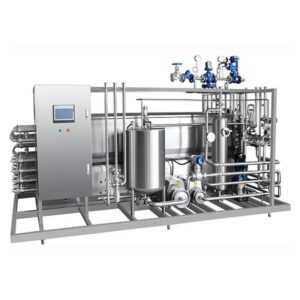
5000L/H Plate Pasteurizer for Milk and Juice Processing
The 5000L/H Plate Pasteurizer for Milk and Juice Processing provides continuous heating, pasteurization, holding, heat recovery, and cooling for liquid food production. Its efficient plate heat exchanger, sanitary stainless steel construction, and precise temperature control make it suitable for milk, juice, beverages, and similar liquid products. Processing temperature, holding time, automation level, and system configuration can be customized for different production requirements.
Compare
Product Overview
The 5000L/H Plate Pasteurizer for Milk and Juice Processing is a continuous thermal processing system designed for the pasteurization of milk, fruit juice, beverages, and other suitable liquid food products.
The system uses a plate heat exchanger to transfer heat efficiently between the product and heating or cooling media. Depending on the required process, it can integrate preheating, heating, pasteurization, holding, heat regeneration, and cooling into one continuous production system.
With a nominal processing capacity of up to 5,000 liters per hour, the machine is suitable for medium-scale dairy plants, juice processing facilities, beverage factories, and other industrial liquid food production applications.
Process temperatures, holding time, outlet temperature, heat recovery configuration, automation level, and auxiliary equipment can be customized according to the characteristics of the processed product.
Key Features
Up to 5000 L/H Processing Capacity
Designed for continuous industrial production with a nominal processing capacity of up to 5,000 liters per hour, depending on product characteristics and process conditions.
Efficient Plate Heat Exchange
The plate heat exchanger provides a large heat transfer surface within a compact structure, allowing efficient heating and cooling of liquid products.
Precise Temperature Control
The pasteurization system can be configured for controlled heating and temperature monitoring to help maintain stable processing conditions throughout continuous production.
Heat Regeneration Design
A heat recovery section can be incorporated to transfer thermal energy between outgoing hot product and incoming cold product, helping reduce heating and cooling energy requirements.
Integrated Heating and Cooling
Preheating, pasteurization, holding, heat recovery, and final cooling can be integrated into a continuous processing system according to the required production process.
Sanitary Stainless Steel Construction
Product-contact piping, tanks, valves, and heat exchange components are designed for hygienic liquid food processing. Stainless steel grades can be selected according to project requirements.
Flexible Process Configuration
Pasteurization temperature, holding time, product inlet and outlet temperatures, flow rate, and heating and cooling conditions can be configured for different products.
Automatic Control Available
The equipment can be configured with manual, semi-automatic, or PLC-based control according to the required level of production automation.
Easy Integration
The plate pasteurizer can be connected with storage tanks, mixing tanks, homogenizers, deaerators, separators, CIP systems, filling machines, and other processing equipment.
Technical Specifications
| Parameter | Specification |
|---|---|
| Equipment Type | Plate Pasteurizer |
| Processing Capacity | Up to 5000 L/H |
| Reference Capacity Range | 4–5 t/h |
| Heat Exchange Area | Approx. 14 m² |
| Installed Power | Approx. 8 kW |
| Steam Consumption | Approx. 1000 kg/h |
| External Dimensions | Approx. 2000 × 1800 × 2000 mm |
| Machine Weight | Approx. 1250 kg |
| Heat Exchange Type | Plate Heat Exchanger |
| Heating Medium | Steam |
| Product Contact Material | Food-grade stainless steel |
| Control Mode | Manual / Semi-automatic / PLC optional |
| Cleaning | CIP-compatible configuration available |
| Application | Milk, juice, beverage and liquid food processing |
Note: The above parameters are reference values based on the supplied 4–5 t/h configuration. Actual capacity, steam consumption, heat exchange area, power, and dimensions may vary according to product viscosity, inlet temperature, pasteurization temperature, holding time, outlet temperature, heating medium, and customized process requirements.
How the Plate Pasteurizer Works
A typical continuous pasteurization process can be configured as:
Product Feeding → Preheating → Heating → Pasteurization → Holding → Heat Regeneration → Cooling → Product Outlet
The untreated liquid first enters the plate heat exchanger, where it can be preheated through heat regeneration. It is then heated to the required pasteurization temperature and maintained under controlled conditions for the specified holding time.
After pasteurization, the hot product transfers part of its heat to the incoming cold product through the regeneration section. The pasteurized product is subsequently cooled to the required outlet temperature before being transferred to downstream storage or filling equipment.
The exact process sequence can be adjusted according to whether the system is used for milk, juice, or other beverages.
Milk Pasteurization Application
For dairy processing, the plate pasteurizer can be incorporated into a production line for:
• Fresh milk
• Pasteurized milk
• Flavored milk
• Goat milk
• Milk beverages
• Dairy-based drinks
Depending on the final product, the system can also be integrated with a milk separator, homogenizer, storage tank, CIP system, and filling equipment.
Juice Pasteurization Application
The system is also suitable for the thermal processing of suitable fruit juices and juice-based beverages, including:
• Apple juice
• Orange juice
• Mango juice
• Pineapple juice
• Grape juice
• Mixed fruit juice
• NFC juice
• Juice beverages
Actual pasteurization parameters should be selected according to the product formulation, acidity, viscosity, pulp or fiber content, packaging method, and required shelf life.
Suitable Applications
The 5000L/H plate pasteurization machine can be used in:
• Dairy processing plants
• Fruit juice processing plants
• Beverage production facilities
• Liquid food factories
• Milk beverage production lines
• Juice filling lines
• Food processing plants
• Centralized liquid food production facilities
Optional Equipment
The plate pasteurizer can be integrated with additional equipment to create a more complete milk, juice, or beverage processing system:
• Balance tank
• Storage tank
• Mixing tank
• Homogenizer
• Milk separator
• Deaerator
• Filter
• CIP cleaning system
• Cooling system
• Product transfer pump
• Buffer tank
• Filling machine
• Packaging equipment
Advantages of Plate Pasteurization
High Heat Transfer Efficiency
The plate heat exchanger provides efficient thermal transfer between the product and heating or cooling media, supporting continuous production while maintaining a compact equipment footprint.
Reduced Energy Consumption
Heat regeneration can recover thermal energy from pasteurized product and reuse it to preheat incoming product, helping improve overall process efficiency.
Continuous Production
Compared with batch pasteurization, continuous plate pasteurization is suitable for production lines requiring stable and uninterrupted product flow.
Flexible Product Processing
Different process configurations can be designed for milk, juice, beverages, and other suitable liquid products.
Hygienic Processing
Sanitary stainless steel piping, valves, pumps, and product-contact components facilitate hygienic operation and cleaning.
Expandable Production System
The pasteurizer can operate as an independent thermal processing unit or be integrated into a complete milk, juice, or beverage production line.
FAQ
1.What is the capacity of this plate pasteurizer?
The nominal processing capacity is up to 5000 L/H. Actual throughput depends on the product characteristics, processing temperature, holding time, and system configuration.
2.Can the same plate pasteurizer process both milk and juice?
Yes. Plate pasteurization systems can be configured for different suitable liquid products. However, milk and fruit juice may require different temperatures, holding times, flow conditions, and cleaning procedures. The process configuration should therefore be selected according to the actual product.
3.Can the pasteurization temperature be customized?
Yes. The heating temperature, pasteurization temperature, holding time, and final cooling temperature can be configured according to the required production process.
4.Can this machine process juice containing pulp?
This depends on the pulp size, fiber content, viscosity, and concentration of the juice. These product characteristics should be confirmed before selecting the plate gap, pump, piping, and heat exchanger configuration.
5.Does the system include cooling after pasteurization?
The system can be configured with heat regeneration and cooling sections so that the product reaches the required outlet temperature before storage or filling.
6.Can a homogenizer be integrated with the pasteurizer?
Yes. A homogenizer can be integrated when required by the dairy or beverage production process.
7.Is CIP cleaning available?
Yes. The system can be designed for integration with a CIP cleaning system to clean the plate heat exchanger, sanitary piping, pumps, valves, and other product-contact components.
8.Can the machine be automatically controlled?
Yes. Manual, semi-automatic, and PLC-based control configurations can be provided according to the required automation level.
9.What information is required for customization?
For accurate equipment configuration, it is recommended to provide the product type, required capacity, inlet temperature, pasteurization temperature, holding time, outlet temperature, product viscosity, solids or pulp content, available utilities, power supply, and required automation level.
Contact us to get your quotation now.
Get in touch with our engineering team.
Related products
-
Milk Pasteurizer
2T/H Milk Pasteurization Plant UHT Yogurt Production Line with Cryogenic Bath Pasteurizer
 Milk Pasteurizer
2T/H Milk Pasteurization Plant UHT Yogurt Production Line with Cryogenic Bath Pasteurizer
1. Materials and heating medium are heated through non-contact heat exchange in their respective sealing systems to ensure the health and safety of materials;
2. Short sterilization time, can ensure that the nutrition of the material is not destroyed;
3. The whole machine is made of food-grade stainless steel material to ensure that it meets the requirements of the national safety and health indicators of beverage and food equipment;
4. Good heat transfer effect, high heat recovery rate, less energy consumption;
5. The main control components, valves and accessories are imported parts, long service life;
6. PLC control can automatically control the heating temperature, hot water temperature and steam flow adjustment of each section of the material, and has automatic material reflux system to ensure that the material 100% sterilization effect;
7. Simple structure, easy to clean, easy to operate, low maintenance cost.SKU: n/a -
Milk Pasteurizer, Pasteurization Equipment
2000L/H Milk Flash Pasteurizer Yogurt Dairy Products Fruit Juice Pasteurization Equipment Plate Type Flow Pasteurizer for Milk Processing Plant
Milk Pasteurizer, Pasteurization Equipment2000L/H Milk Flash Pasteurizer Yogurt Dairy Products Fruit Juice Pasteurization Equipment Plate Type Flow Pasteurizer for Milk Processing Plant
- Capacity: 2000L/H
- Total power: 5.5KW
- Steam consumption: 500KG/H
- Size: 1600×1600×1800mm
- Weight: 1000kg
NOTE: Prices may vary by product model and material.
SKU: n/a -
Milk Pasteurizer
1T/H Milk Pasteurizer Machine High Temperature Instant Sterilization System
1. Application: The pipeline sterilizer can be used for sterilizing dairy products, liquid food and beverage, concentrated jam, biology, and other types of medicine.
2. Main structure: material tank, sterilization tank, material pump, heat exchanger, hot water intersection, controller, etc.
3. Working principle: Pre-sterilize, sterilize the pipelines in contact with the materials, use the hot water circulation in the pipelines, for more than 20 minutes, then lower the temperature of the pipelines, and start to sterilize the materials. Disposal material is tanked and pumped to a pipeline heat exchanger. Then put the material into the heating tube for sterilization according to the required time, after sterilization, enter the insulation tube, enter the cooling tube and send it to the filling machine.SKU: n/a