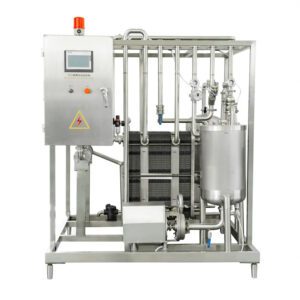
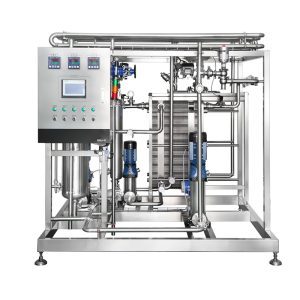
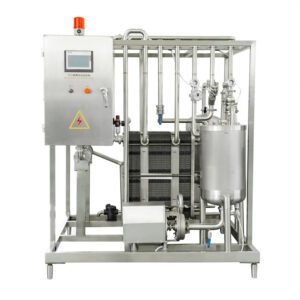
2000L/H Tubular UHT Sterilizer for Liquid Food and Beverage
The 2000L/H Tubular UHT Sterilizer is engineered for continuous thermal treatment of milk, juice, yogurt beverages, and other liquid foods. Its tubular heat exchange system combines rapid heating, controlled holding, heat recovery, and cooling in one process. With automatic temperature regulation, CIP-compatible sanitary construction, and flexible outlet temperature settings, the system can be configured for aseptic, cold, or hot filling applications.
Compare
Product Overview
The 2000L/H Tubular UHT Sterilizer for Liquid Food and Beverage is a continuous thermal processing system developed for products requiring controlled high-temperature treatment before filling or further processing.
Unlike plate-type heat exchangers, the tubular configuration passes the product through sanitary tubes surrounded by a heating or cooling medium. This construction provides a robust heat transfer solution for a wide range of liquid foods and can accommodate products with different viscosities and processing characteristics when properly configured.
The standard system has a nominal processing capacity of 2 tons per hour and integrates product feeding, regenerative heat exchange, heating, holding, cooling, and automatic process control.
Heat recovery of up to approximately 90% under suitable operating conditions can help reuse thermal energy during processing and reduce utility requirements.
The equipment can be connected to downstream aseptic filling, cold filling, or hot filling systems according to the required production process.
Technical Parameters
Based on the 2 t/h configuration provided:
| Parameter | Specification |
|---|---|
| Equipment | Tubular UHT Sterilizer |
| Processing Capacity | 2000 L/H / approx. 2 t/h |
| Reference Model | DG-UHT-2 |
| Steam Consumption | Approx. 260 kg/h |
| Steam Pressure | Approx. 2.5 bar |
| Electric Power | Approx. 2.1 kW |
| Overall Dimensions | Approx. 3.5 × 1.6 × 2.0 m |
| Machine Weight | Approx. 1600 kg |
| Product Pipe Caliber | Φ25 |
| Steam Connection | DN32 |
| Medium Connection | 25 |
| Heat Exchange Structure | Tubular |
| Operation | Continuous |
| Cleaning | CIP-compatible |
| Control | Automatic configuration available |
| Application | Liquid food and beverage |
The specifications above are reference values for the 2 t/h configuration. Final parameters may change according to product properties, inlet and outlet temperatures, required treatment conditions, heat recovery design, utilities, and customized configuration.
Designed for Continuous UHT Processing
The system is designed to maintain continuous product movement throughout the thermal treatment process. Instead of heating an entire batch inside a vessel, the liquid travels through a controlled tubular circuit where different thermal stages can be performed sequentially.
A typical configuration may include:
Product Feeding → Regenerative Preheating → Homogenization (if required) → High-Temperature Treatment → Holding → Heat Recovery → Final Cooling → Filling
For certain products, the material can first be heated to approximately 65–70°C before homogenization. It then proceeds to the required thermal treatment stage.
After treatment, the product can be cooled to approximately 4–25°C for an appropriate downstream cold or aseptic filling process, or maintained at a higher outlet temperature when hot filling is required.
Actual temperatures and holding times must be determined according to the product formulation, microbiological target, filling method, packaging system, and required shelf life.
Core Advantages
Tubular Heat Exchange Structure
The tubular heat exchanger provides a durable thermal processing path for liquid foods. The system can be engineered according to product viscosity, flow characteristics, solids content, and required heat treatment conditions.
High Heat Regeneration Efficiency
Under suitable operating conditions, approximately 90% heat recovery can be achieved. Heat from the treated product is reused to preheat incoming product, reducing unnecessary steam and cooling demand.
Stable Thermal Treatment
Automatic regulation of steam, product flow, and other process variables helps maintain the required treatment temperature and reduce fluctuations during continuous operation.
Integrated Homogenization Process
When required, the product can be heated to the appropriate homogenization temperature before entering an optional homogenizer and subsequently returned to the sterilization system for further thermal treatment.
Flexible Final Product Temperature
The cooling section can be configured according to the downstream filling process, allowing the product to be prepared for aseptic filling, cold filling, or hot filling.
Hygienic Internal Pipeline Design
Product-contact tubes are designed for sanitary food processing. Smooth internal surfaces and hygienic connections facilitate effective circulation and cleaning.
Automated Process Protection
Steam pressure, hot-water conditions, product flow, and temperature can be incorporated into the control and alarm system to support stable and safe operation.


Heat Recovery and Energy Efficiency
A major advantage of a continuous tubular UHT system is the ability to recover thermal energy.
Instead of discarding the heat contained in the sterilized product, the regeneration section transfers part of this energy to the incoming cold product.
This provides two benefits:
• Lower heating demand: incoming product reaches the heating section at a higher temperature.
• Lower cooling demand: outgoing product loses part of its heat before entering the final cooling stage.
• Under suitable process conditions, the supplied configuration indicates heat recovery efficiency of up to approximately 90%.
Suitable Products
The 2000L/H tubular sterilization system can be configured for a broad range of liquid food and beverage applications, including:
• fresh milk
• flavored milk
• dairy beverages
• yogurt drinks
• plant-based beverages
• fruit juice
• vegetable juice
• juice beverages
• tea beverages
• protein drinks
• liquid nutritional products
• other pumpable liquid foods
For products containing pulp, fibers, particles, or higher viscosity, the product characteristics should be evaluated before determining tube diameter, pump configuration, flow velocity, and thermal processing conditions.
FAQ
1.What is the production capacity of this tubular UHT sterilizer?
This configuration is designed for approximately 2000 L/H, or around 2 t/h for products with a density close to water. Actual throughput should be confirmed according to the processed material and thermal treatment requirements.
2.What products can be processed?
The system can be configured for milk, dairy beverages, yogurt drinks, fruit juice, vegetable juice, plant-based beverages, tea drinks, and other suitable pumpable liquid foods.
3.Why use a tubular heat exchanger instead of a plate heat exchanger?
Tubular systems provide a different product flow path and can be advantageous for certain products with higher viscosity or more demanding flow characteristics. The correct heat exchanger should be selected according to the actual product rather than capacity alone.
4.Can the machine process products containing pulp or particles?
Potentially, yes, but particle size, pulp content, fiber content, viscosity, and solids concentration must be confirmed first. These parameters influence tube diameter, pump selection, flow conditions, and heat exchanger design.
5.Is a homogenizer included?
A homogenizer can be integrated when required. For some dairy and beverage applications, the product can be preheated to the appropriate temperature before homogenization and then continue through thermal treatment.
6.Can the product be cooled immediately after treatment?
Yes. The system can incorporate regenerative cooling and final cooling sections. The target outlet temperature is selected according to the subsequent filling process.
7.Can it be connected to an aseptic filling machine?
Yes. The UHT sterilizer can form part of an aseptic processing line, but the complete sterile boundary, buffer system, filling interface, and sanitation requirements must be considered during project design.
8.Does the system support CIP cleaning?
Yes. The product-contact circuit can be designed for CIP circulation, and automated cleaning sequences can be incorporated according to the required control configuration.
9.How much steam does the 2000L/H model consume?
The supplied reference specification indicates approximately 260 kg/h at 2.5 bar for the 2 t/h configuration. Actual consumption varies with inlet temperature, treatment temperature, heat recovery efficiency, product properties, and operating conditions.
10.Can the equipment parameters be customized?
Yes. Capacity, tube configuration, material, temperature profile, holding time, cooling conditions, automation, CIP functions, utilities, and downstream interfaces can all be configured according to the project.
Contact us to get your quotation now.
Get in touch with our engineering team.
Related products
-
Beer Pasteurizer
20BBL/H Beer Flow Pasteurizer Ice Cream Juice Milk Commercial Pasteurization Plant Budweiser Beer Large IPA Plate Pasteurizer
 Beer Pasteurizer
20BBL/H Beer Flow Pasteurizer Ice Cream Juice Milk Commercial Pasteurization Plant Budweiser Beer Large IPA Plate Pasteurizer
- Capacity: 20BBL/H
- Heat exchanging area: 8m²
- Total power: 5.5KW
- Steam consumption: 200KG/H
- Size: 1700×1700×1800mm
- Weight: 980kg
NOTE: Prices may vary by product model and material.
SKU: n/a -
Beer Pasteurizer
UHT Tubular Sterilizer for Juice and Milk Processing Price
UHT tubular sterilizer is an advanced continuous sterilization system designed for juice, milk, beverage, and liquid food processing. It supports high-viscosity and particle-containing products while maintaining original flavor and nutrition. With high heat recovery efficiency up to 85%, PID temperature control system, and automatic CIP cleaning, it ensures stable sterilization performance, hygienic production, and energy-saving operation for modern food and beverage industries.
SKU: n/a -
Beer Pasteurizer
2000L/H Beer Plate Pasteurizer Machine Manufacturer
The 2000L/H beer plate pasteurizer machine is a high-efficiency thermal processing system designed for continuous pasteurization of beer and other low-viscosity beverages. This beer pasteurization machine adopts advanced plate heat exchanger technology to ensure rapid heat transfer, precise temperature control, and consistent product quality.
This brewery pasteurizer system is widely used in craft breweries, industrial beer production plants, and beverage processing facilities. With a compact structure, hygienic design, and customizable configurations, it provides an ideal solution for extending shelf life while preserving the original flavor of beer.
SKU: n/a -
Beer Pasteurizer
30BBL/H Flow Pasteurizer for Beer and Beverage Processing
The 30BBL/H flow pasteurizer is designed for beer, juice, and beverage processing. Constructed from food-grade stainless steel, it ensures precise temperature control, stable pasteurization, and consistent product quality. Equipped with a plate heat exchanger and automatic CIP system, this unit delivers hygienic, energy-efficient, and reliable performance—ideal for breweries and beverage production lines.
SKU: n/a