
Automatic CIP System for Food and Beverage Processing
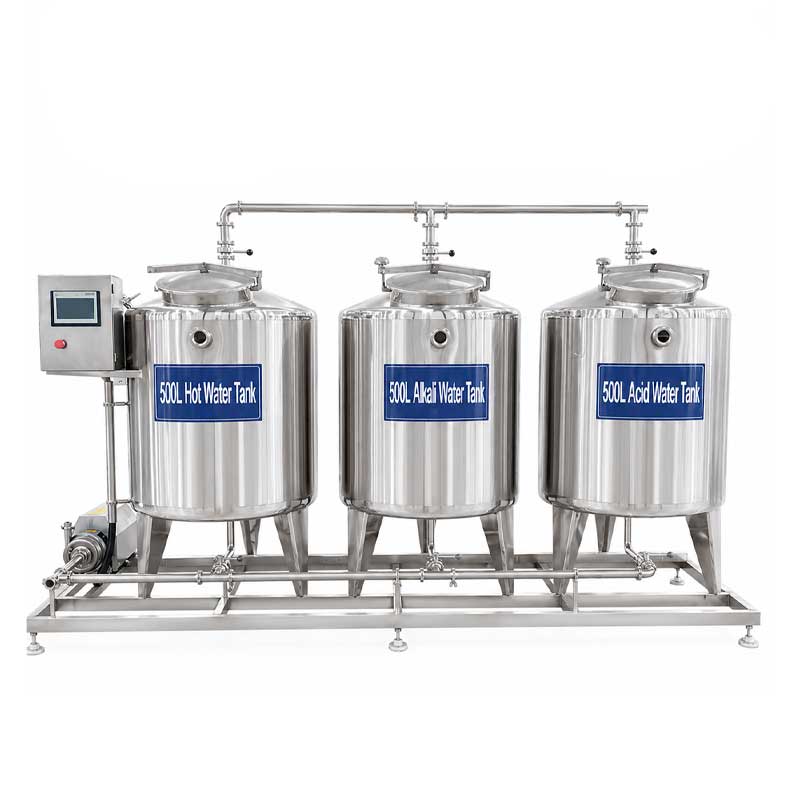
The Automatic CIP System provides efficient clean-in-place washing for tanks, pipelines, pumps, valves, heat exchangers, and other food processing equipment without routine disassembly. Featuring stainless steel solution tanks, a circulation pump, sanitary piping, and automatic process control, the system supports controlled water, alkali, acid, and rinsing cycles for dairy, beverage, juice, sauce, brewery, and other hygienic food production lines.
Compare
CIP System Product Overview
The Automatic CIP System for Food and Beverage Processing is designed for centralized cleaning of product-contact equipment used in hygienic production facilities.
Instead of repeatedly dismantling tanks and pipelines for manual cleaning, the CIP system circulates water and prepared cleaning solutions through the connected processing circuit. Cleaning temperature, circulation time, flow conditions, and chemical concentration can be controlled according to the selected configuration and validated cleaning procedure.
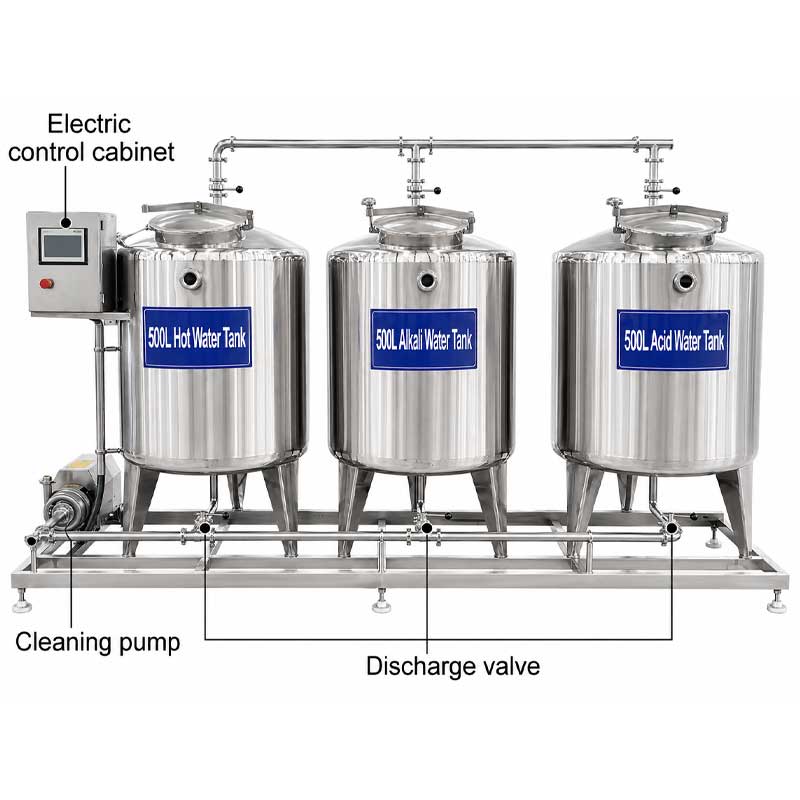
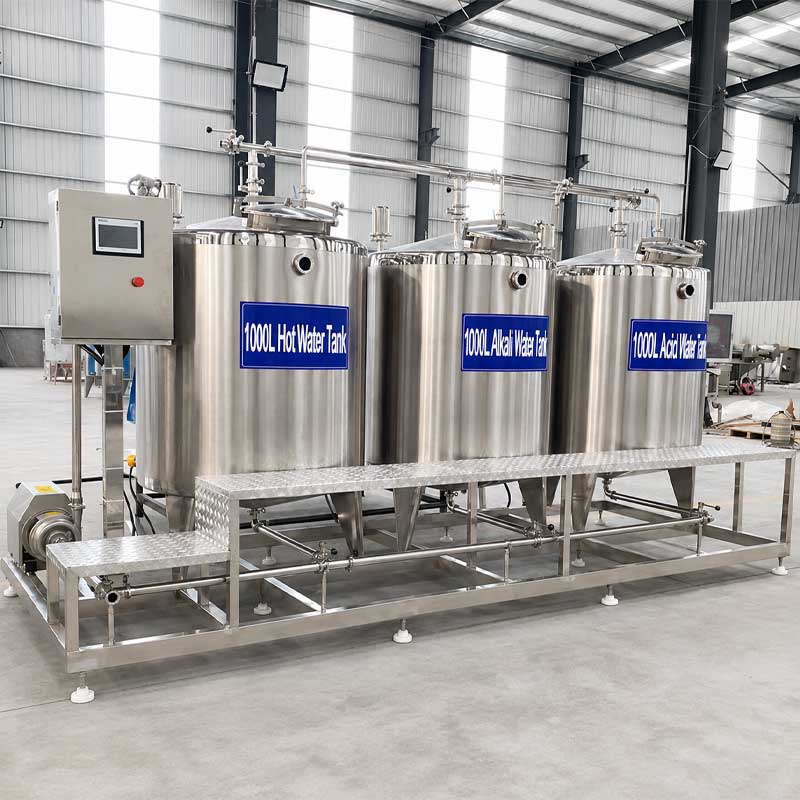
A typical three-tank configuration consists of:
Hot Water Tank + Alkali Tank + Acid Tank + CIP Pump + Control System + Sanitary Piping and Valves
The system can be connected to processing tanks, pipelines, pumps, heat exchangers, filling equipment, and other compatible production machinery. Three-, four-, and five-tank configurations are also possible depending on the required cleaning process.It is suitable for dairy plants, beverage factories, juice processing lines, sauce production, breweries, liquid food facilities, and other applications requiring repeatable cleaning-in-place procedures.
How the CIP System Works
The CIP system prepares and circulates cleaning media through the equipment that requires cleaning.
A typical cleaning sequence may include:
Pre-Rinse → Alkali Cleaning → Intermediate Rinse → Acid Cleaning → Final Rinse → Sanitization / Hot Water Cycle if Required
The actual sequence is determined by the product residue, equipment design, cleaning chemistry, hygiene requirements, and validated sanitation procedure.
During operation, the circulation pump sends cleaning solution from the selected CIP tank through the connected processing equipment and pipelines. The cleaning liquid can then be returned to the CIP station for circulation, recovery, or discharge depending on the system design.
Automatic configurations can control parameters such as temperature, cleaning time, flow, and chemical concentration, helping improve repeatability between cleaning cycles.
Main Components
1. Hot Water Tank
The hot water tank stores heated water for hot rinsing, cleaning-solution preparation, or other stages of the CIP cycle.Depending on the system design, heating can be configured according to the available plant utilities and required cleaning temperature.
Temperature monitoring and automatic control can be incorporated to maintain the programmed cleaning conditions.
2. Alkali Tank
The alkali tank stores the caustic cleaning solution used during the alkaline cleaning stage.Alkaline cleaning is commonly incorporated into CIP programs for removing suitable organic residues such as fats, proteins, and other process soils.
Automatic systems can also be configured with chemical dosing and concentration monitoring according to project requirements.
3. Acid Tank
The acid tank stores the acidic cleaning solution used during the acid cleaning stage.Acid cleaning may be incorporated where removal of mineral deposits, scale, or other acid-soluble residues is required.
The exact chemical, concentration, temperature, and circulation time must be determined according to the equipment being cleaned and the facility’s cleaning procedure.
4. CIP Circulation Pump
A sanitary circulation pump transfers cleaning liquid from the CIP tanks through the connected equipment and piping circuit.
Proper flow conditions are important because CIP performance depends not only on chemical action but also on mechanical action generated by fluid movement.
5. Control System
The control cabinet coordinates the CIP cleaning sequence.PLC and HMI control can be incorporated into fully automatic systems for recipe-based CIP operation.
6. Sanitary Piping and Valves
The CIP tanks are connected through a sanitary piping network with valves and fittings that direct the required cleaning medium into the selected cleaning circuit.
Key Features
Automatic Cleaning Cycles
PLC-based control can automate multiple stages of the CIP sequence, reducing dependence on manual valve operation and improving process repeatability.
Three-Tank Cleaning Configuration
A typical system uses dedicated hot water, alkali, and acid tanks to support different cleaning stages.
Cleaning Without Routine Equipment Disassembly
CIP technology allows internal product-contact surfaces of appropriately designed tanks and pipelines to be cleaned through circulation rather than routine dismantling.
Controlled Cleaning Parameters
Cleaning temperature, time, flow conditions, and chemical concentration can be managed according to the selected automation configuration.
Stainless Steel Construction
Food-processing CIP stations are commonly available in SUS304 or SUS316L, with material selection based on cleaning chemistry, process requirements, and customer specification.
Chemical Dosing Available
Automatic acid and alkali dosing can be incorporated to prepare and maintain cleaning solutions according to the required process.
Technical Specifications
| Parameter | Specification |
|---|---|
| Product Name | Automatic CIP System |
| Application | Food, beverage, dairy and liquid processing |
| Cleaning Method | Clean-in-Place circulation |
| Typical Configuration | Hot water + alkali + acid |
| Tank Quantity | 1 / 2 / 3 / multiple tanks |
| Tank Capacity | Customizable |
| Tank Material | SUS304 / SUS316L optional |
| Cleaning Circuit | Single or multiple circuits |
| CIP Pump | Sanitary centrifugal pump |
| Heating Method | Configured to project requirements |
| Temperature Control | Available |
| Chemical Dosing | Manual / automatic optional |
| Conductivity Monitoring | Optional |
| Flow Monitoring | Optional |
| Level Control | Available |
| Valve Control | Manual / pneumatic automatic |
Cleaning Process
- Pre-Rinse
Water is circulated through the equipment to remove loose product residue and prepare the circuit for chemical cleaning. - Alkali Cleaning
Prepared alkaline solution is circulated through the equipment according to the required temperature, concentration, flow, and cleaning time. - Intermediate Rinse
Water removes remaining alkaline solution before the next cleaning stage. - Acid Cleaning
Where required, acidic solution is circulated to address mineral deposits and other acid-soluble soils. - Final Rinse
Fresh water is used to remove residual cleaning chemicals from the processing circuit. - Sanitization
Depending on the production process, an additional hot-water or approved chemical sanitization stage may be incorporated.
Applications
- Dairy Processing
Suitable for cleaning appropriately CIP-designed milk tanks, yogurt processing equipment, pasteurizers, pipelines, pumps, and other dairy processing circuits. - Beverage Production
Can be integrated with juice, soft drink, tea beverage, and other liquid-processing systems. - Juice Processing
Suitable for cleaning tanks, heat exchangers, pipelines, pumps, and compatible filling-related circuits used in fruit juice production. - Sauce and Liquid Food Processing
Can be configured for processing systems handling suitable sauces, syrups, liquid foods, and similar products. - Brewery Equipment
CIP systems are widely used for cleaning brewhouse vessels, fermentation tanks, bright beer tanks, process piping, and related equipment. - Food Processing Lines
Can serve as a centralized cleaning station for multiple compatible processing machines and production circuits.
How to Select the Right CIP System
Before designing a CIP station, the cleaning requirements of the complete production facility should be reviewed.
The most important information includes:
- Equipment to Be Cleaned:
Tanks, pipelines, heat exchangers, fillers, pasteurizers, fermenters, etc. - Number and Volume of Tanks:
The size and quantity of process vessels affect CIP flow and solution requirements. - Pipeline Diameter and Length:
These influence the required pump flow and head. - Product:
Milk, juice, beverage, beer, sauce, syrup, puree, or other food product. - Product Residue:
Fat, protein, sugar, fruit solids, mineral deposits, or other soils. - Number of Cleaning Circuits:
Determine whether equipment will be cleaned sequentially or simultaneously. - Cleaning Chemicals:
Confirm the acid, alkali, sanitizer, and concentration ranges to be used. - Heating Utility:
Steam, electric heating, hot water, or another available heat source. - Automation Level:
Manual, semi-automatic, or fully automatic PLC operation. - Available Utilities:
Electricity, steam, water, compressed air, and drainage. - Factory Layout:
CIP station location and distances to the equipment being cleaned.
These details are more important than selecting a CIP system simply according to tank volume.
FAQ
What is an automatic CIP system?
An automatic CIP system is a clean-in-place station that circulates water and cleaning solutions through tanks, pipelines, heat exchangers, pumps, and other compatible processing equipment without routine disassembly.
What does CIP mean?
CIP means Clean-in-Place, referring to cleaning the internal product-contact surfaces of appropriately designed processing equipment while the equipment remains assembled.
What tanks are included in a three-tank CIP system?
A typical three-tank system consists of a hot water tank, alkali tank, and acid tank.
Can the CIP tank capacity be customized?
Yes. Tank capacity should be selected according to the equipment volume, piping circuit, cleaning requirements, and plant layout. Commercial systems are available across a wide capacity range.
Can the system automatically add acid and alkali?
Yes. Automatic chemical dosing can be incorporated. Some fully automatic systems use conductivity measurement together with dosing controls to manage cleaning-solution concentration.
Can the CIP system clean several production lines?
Yes, if it is designed with the appropriate number of cleaning circuits, valve routing, pumps, flow capacity, and controls. Single- and multi-circuit CIP stations are available.
Can it clean filling machines?
CIP-compatible product circuits within filling equipment can be connected where the filler is designed for CIP. Commercial CIP stations are also used with filling machines, tanks, pipelines, and heat exchangers.
Contact us to get your quotation now.
Get in touch with our engineering team.
Related products
-
Automatic CIP Systems
CIP Cleaning System Manufacturer 500L Brewery Tank Unit
The 500L CIP cleaning system is a stainless steel automated cleaning solution designed for breweries, beverage, and food processing industries. It enables efficient internal cleaning of tanks, pipes, and valves without disassembly. With programmable washing cycles, chemical circulation, and sterilization functions, it ensures hygienic production, reduces downtime, and improves operational efficiency for craft breweries, microbreweries, and industrial beverage plants.
SKU: n/a -
Automatic CIP Systems
Automatic Tank Cleaning System, Beer Brewing Cleaning System
With its core advantages of “high efficiency, safety, intelligence, and environmental protection”, the Automatic Tank Cleaning System has completely revolutionized the cleaning mode of industrial containers. It not only helps enterprises improve production compliance and product quality stability, but also creates considerable economic benefits for enterprises through cost reduction, efficiency improvement, and risk prevention and control. It is an indispensable intelligent cleaning equipment in modern industrial production.
SKU: n/a -
Automatic CIP Systems
Stainless Steel CIP System for Milk Processing Line Price
Stainless steel CIP system is an automatic cleaning solution designed for food, beverage, dairy, and brewery industries. It enables precise control of cleaning temperature, flow rate, pressure, and chemical concentration through PLC and touch screen interface. The system supports automatic detergent dosing, self-circulation switching, and real-time monitoring, ensuring efficient and hygienic cleaning of tanks and pipelines without disassembly.
SKU: n/a -
CIP System
Stainless Steel CIP System for Dairy and Juice Processing
This versatile CIP cleaning system provides reliable automated cleaning for tanks, pipelines, pumps, valves, and processing equipment used in dairy, wine, juice, oil, and food production. Available with one to five cleaning tanks and capacities from 10 to 200 HL, the system supports manual, semi-automatic, or fully automatic operation. Steam or electric heating options enable effective temperature control, while sanitary construction helps improve cleaning consistency and reduce production downtime.
SKU: n/a


