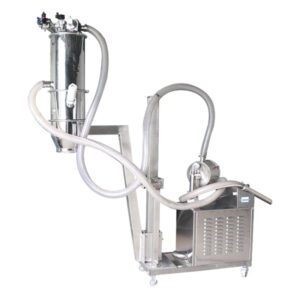
Pneumatic Vacuum Conveyor for Automated Powder Loading
Pneumatic Vacuum Conveyor is an efficient and hygienic solution for automatic transportation of powders, granules, and bulk materials. Using vacuum airflow technology, it transfers materials through a sealed pipeline with low dust emission and stable performance. Designed for food, pharmaceutical, chemical, ceramic, and industrial applications, this system reduces manual handling, improves production efficiency, and provides safe material feeding for mixers, packaging machines, filling equipment, and other processing systems.
Compare
Product introduction of Pneumatic Vacuum Conveyor
Pneumatic Vacuum Conveyor is an advanced pneumatic conveying system designed for the automatic transfer of powder, granule, and bulk materials in various industrial production processes. The system uses negative pressure generated by a vacuum source to create airflow, drawing materials from the feeding point and transporting them through a closed pipeline.
During operation, the material and air mixture enters the conveyor system, where the filter separates the product from the conveying air. The clean air is discharged through the vacuum unit, while the separated material falls into the receiving hopper or connected production equipment.
Compared with traditional manual feeding methods, the Pneumatic Vacuum Conveyor provides a cleaner, safer, and more efficient material handling solution. The enclosed conveying structure helps prevent dust leakage, reduces contamination risks, and improves the working environment.
The system can be integrated with various production machines, including tablet presses, capsule filling machines, packaging machines, mixers, vibrating screens, granulators, crushers, and storage silos. Its compact structure, automatic operation, and flexible configuration make it suitable for modern automated production lines.
With customizable materials, hopper sizes, control systems, and explosion-proof options, the pneumatic conveying system can meet different production requirements in industries requiring reliable and hygienic powder handling.
Working Principle
The Pneumatic Vacuum Conveyor works based on vacuum suction and airflow transportation technology.
- The vacuum generator creates negative pressure inside the conveying pipeline.
- The suction force draws powder or granular materials from bags, containers, hoppers, or storage units.
- Materials are transported together with airflow through the sealed conveying pipe.
- The filter system separates materials from the air stream.
- The material enters the receiving equipment through the discharge valve.
- The filter is automatically cleaned by compressed air backflushing to maintain stable conveying efficiency.
- The system repeats the conveying cycle automatically.
This working method ensures continuous, clean, and reliable material transfer.
Product Parameter Table
| Parameter | Specification |
| Conveying Type | Pneumatic vacuum conveying |
| Hopper Capacity | 60 L |
| Working Pressure | 0.4–0.6 MPa |
| Conveying Capacity | 900–6000 kg/h |
| Compressed Air Consumption | 2880 NL/min |
| Conveying Material | Powder, granule and bulk material |
| Material Contact Parts | Stainless steel |
| Control Method | Automatic control |
| Filter Cleaning | Compressed air pulse backflushing |
| Application | Food, pharmaceutical, chemical and industrial material handling |
Main Features
- Dust-Free Material Transfer
The enclosed conveying design minimizes dust generation during operation, helping maintain a cleaner production environment and protecting product quality.
- Automatic Material Feeding
The system provides automatic transportation of powders and granules without manual handling, improving production efficiency and reducing labor costs.
- Safe and Reliable Operation
Vacuum-based conveying avoids direct contact during material transfer and provides safer operation, especially for fine powders and sensitive materials.
- Wide Material Compatibility
The equipment can handle various powders, granules, and bulk materials used in food, pharmaceutical, chemical, ceramic, and industrial production.
- Easy Integration with Production Equipment
The system can directly feed mixers, packaging machines, filling machines, tablet presses, granulators, crushers, and storage equipment.
- Compact Structure
The small footprint design makes installation easier and allows flexible placement in different production environments.
- Low Noise Operation
The vacuum conveying process produces low vibration and reduced operating noise compared with many mechanical conveying methods.
- Easy Cleaning and Maintenance
The simple structure and removable filter system allow convenient cleaning and maintenance, supporting hygienic production requirements.
- Flexible Configuration
The system can be customized with different hopper sizes, materials, control systems, discharge methods, and conveying layouts.
- Explosion-Proof Option Available
For applications involving combustible powders, explosion-proof electrical components and special configurations can be provided.
Application Areas
- Pharmaceutical Industry
The Pneumatic Vacuum Conveyor is widely used for transferring pharmaceutical powders, granules, and active ingredients while maintaining clean and controlled production conditions.
- Food Processing Industry
It is suitable for conveying flour, sugar, starch, milk powder, spices, additives, and other food ingredients with hygienic requirements.
- Chemical Industry
The system can transport chemical powders, pigments, additives, and fine particles safely through an enclosed pipeline system.
- Ceramic Industry
It can handle ceramic powder, raw materials, and fine particles during mixing, processing, and production operations.
- Plastic Processing Industry
The equipment is suitable for conveying plastic pellets, resin particles, and other polymer materials to processing machines.
- Battery and New Energy Industry
The system can be used for transferring fine powder materials in battery production and advanced material processing.
Equipment Connection Applications
The Pneumatic Vacuum Conveyor can be connected with:
- tablet press
- capsule filling machine
- packaging machine
- mixer
- vibrating screen
- dry granulator
- crusher
- storage silo
- hopper
- filling equipment
It provides an efficient automatic feeding solution for complete production lines.
Advantages of Pneumatic Vacuum Conveyor
- Automatic powder and granule transportation
- Reduces manual material handling
- Dust-free closed conveying process
- Improves production efficiency
- Prevents material contamination
- Easy installation and operation
- Low noise operation
- Energy-efficient conveying principle
- Suitable for GMP production environments
- Flexible customization options
Customizable Configurations
Material Selection
The system can be manufactured with different materials according to application requirements:
- stainless steel 304
- stainless steel 316L
- carbon steel
Control System
Available control options include:
- automatic control panel
- PLC control system
- customized operation settings
Conveying Configuration
The system can be customized according to:
- conveying distance
- conveying height
- material characteristics
- production capacity
- discharge method
Safety Configuration
Optional configurations include:
- explosion-proof electrical components
- conductive filters
- special sealing structures
- enhanced filtration systems
FAQ
- What materials can a Pneumatic Vacuum Conveyor transport?
The system can transport powders, granules, and bulk materials including food ingredients, pharmaceutical powders, chemical additives, ceramic materials, and plastic particles.
- How does a pneumatic vacuum conveyor work?
It uses vacuum pressure to create airflow that draws materials through a sealed pipeline and separates the material from air through a filter system.
- What are the advantages compared with mechanical conveyors?
The pneumatic vacuum conveying system provides cleaner operation, lower dust generation, easier installation, and better flexibility for different production environments.
- Is the system suitable for pharmaceutical production?
Yes. With stainless steel construction and hygienic design options, it is suitable for pharmaceutical applications requiring clean material transfer.
- Can the conveyor feed multiple machines?
Yes. The system can be designed to supply different production machines such as mixers, packaging equipment, filling machines, and processing units.
- Does the system require manual operation?
No. The conveying process can be automatically controlled according to preset parameters, reducing operator involvement.
- Can the equipment handle explosive powders?
Yes. Explosion-proof configurations are available for applications involving combustible or hazardous materials.
- How is the filter cleaned?
The filter can be cleaned automatically through compressed air pulse backflushing, helping maintain stable airflow and conveying performance.
Contact us to get your quotation now.
Get in touch with our engineering team.
Related products
-
Pneumatic Conveying Equipment/Pneumatic Conveyor
Mobile Grain Corn Suction Machine Pneumatic Wheat Conveyor Unloader Loader Pneumatic Vacuum Grain Conveyor 100 t
 Pneumatic Conveying Equipment/Pneumatic Conveyor
Mobile Grain Corn Suction Machine Pneumatic Wheat Conveyor Unloader Loader Pneumatic Vacuum Grain Conveyor 100 t
1. The pipe standard length is 30m, we can increase it according to the customer’s requirement
2. Besides normal capacity, we can customize according to the customer’s requirement
3. voltage can be customized as required.SKU: n/a -
-
Pneumatic Conveying Equipment/Pneumatic Conveyor
Pneumatic Vacuum Conveyor Automatic Vacuum Transfer System for Fine Powder Tablet
Pneumatic Conveying Equipment/Pneumatic ConveyorPneumatic Vacuum Conveyor Automatic Vacuum Transfer System for Fine Powder Tablet
Vacuum conveyors can be widely used in magnetic materials industry, food processing industry, plastic processing industry, lithium power industry, coatings industry, chemical industry and pharmaceutical industry etc.
The vacuum feeder uses a vacuum pump to suction the air, so that the inlet of the suction nozzle and the whole system are in a certain vacuum state. The powder particles are sucked into the nozzle along with the outside air to form a gas stream, which passes through the suction pipe and reaches the hopper in the hopper. Gas and material separation. The separated material enters the receiving equipment. The feeding and discharging are completed by continuously opening and closing the pneumatic three-way valve, and the opening and closing of the pneumatic three-way valve is controlled by the control center.
SKU: n/a