


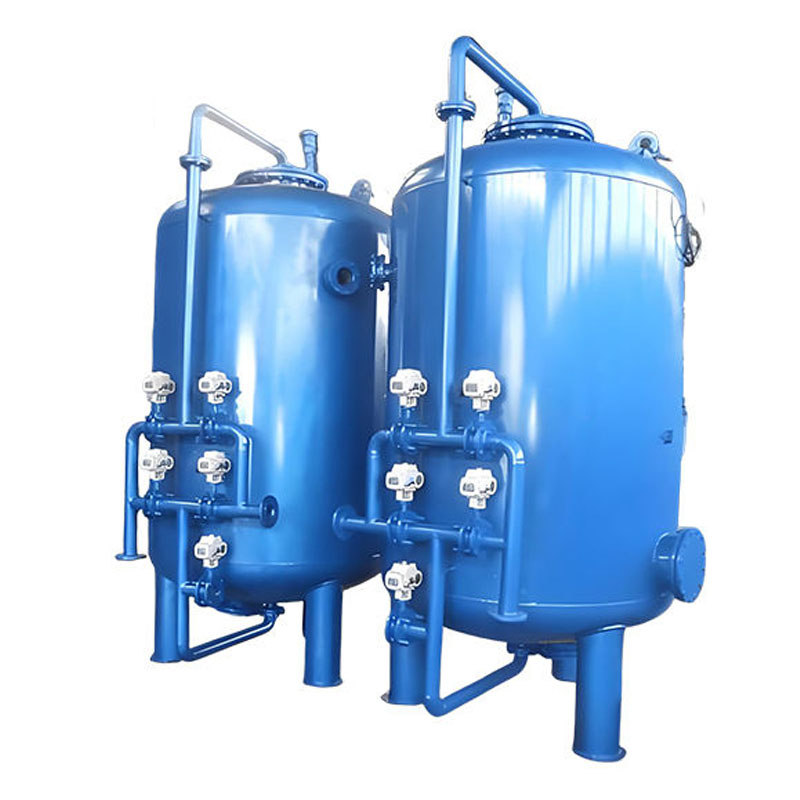

30 m³/h Multi-Media Filter for Aquaculture Water Treatment
The 30 m³/h multi-media filter is a pressure-driven water treatment unit designed to remove suspended solids, turbidity, and fine particles through layered filtration media such as anthracite and quartz sand. It is widely used in aquaculture, municipal, and industrial water systems. By combining adsorption and mechanical interception, it ensures stable effluent quality. The system supports automatic backwashing, improving filtration efficiency and reducing maintenance in continuous operation environments.
Compare
Product introduction of 30 m³/h Multi-Media Filter
The 30 m³/h multi-media filter is a pressure-type filtration system designed for solid-liquid separation in water treatment processes. It typically consists of a corrosion-resistant steel vessel filled with graded filter media such as anthracite, quartz sand, and gravel layers. The equipment is engineered to reduce suspended solids, colloids, and turbidity in raw water, making it suitable for pre-treatment and circulation systems. It is widely used in aquaculture, municipal water supply, and industrial process water systems where stable water quality is required. It helps operators meet strict water quality standards efficiently.
Working principle
The multi-media filter operates using pressure-driven downward flow through layered filter materials. Raw water enters the vessel and passes through anthracite, quartz sand, and supporting gravel layers. Suspended solids are captured by adsorption and mechanical interception as water moves through progressively finer media layers. Over time, accumulated impurities increase resistance, and the system initiates backwashing to restore filtration capacity. This cycle ensures continuous removal of turbidity and stable water quality output in various treatment applications.
Product Parameter Table
| Processing Capacity | 30 m³/h |
| Influent and Effluent | DN125 |
| Filtering speed | 8-12 m/h |
| Tank size | ø 2000×2550 mm |
| Quartz sand consumption | 5650 kg |
Main Features
- The multi-layer filtration structure improves removal efficiency for suspended solids and fine particles.
- Automatic backwashing system reduces manual intervention and maintains long-term stable filtration performance.
- Pressure-type design ensures consistent water flow and high treatment capacity under continuous operation conditions.
- Flexible filter media configuration allows adaptation to different water quality and treatment requirements.
- Corrosion-resistant tank structure ensures durability in industrial and aquaculture water environments.
- Simple maintenance design reduces downtime and supports reliable operation in remote installations.
Application Scenarios
- Municipal water treatment plants for raw water clarification and suspended solid removal before distribution.
- Industrial circulating water systems to reduce turbidity and prevent scaling and pipeline blockage.
- Aquaculture water purification systems for maintaining stable oxygen and clean fish farming environments.
- Surface water pre-treatment applications including low-turbidity or sediment-laden water sources.
FAQ
Q1: What is the main function of a multi-media filter?
It removes suspended solids, turbidity, and fine particles through layered filtration media.
Q2: What filter media are commonly used?
Typical media include anthracite, quartz sand, and graded gravel layers.
Q3: Does the system support automatic operation?
Yes, it usually includes automatic backwashing for continuous and stable performance.
Q4: What industries commonly use this equipment?
It is widely used in aquaculture, municipal water treatment, and industrial circulation systems.
Q5: What is the advantage over single-media filters?
It provides higher filtration accuracy and longer operation cycles before maintenance.
Contact us to get your quotation now.
Get in touch with our engineering team.
Related products
-
Industrial Centrifuge
1600 RPM Centrifugal Separator For Juice Clarification System
The 1600 RPM centrifugal separator is an industrial solid-liquid separation machine designed for efficient filtration, dewatering, and batch processing. It operates with a flat-plate structure and liquid damping vibration reduction system, enabling stable performance without foundation installation. The equipment is suitable for handling suspensions requiring hygienic and controlled separation. It is widely used in chemical, pharmaceutical, and food industries where safe, clean, and repeatable separation processes are required under continuous or batch production conditions.
SKU: n/a -
Water Purification & Filtration
Water Purification & Filtration Factory RO Purifier
This industrial-grade Factory RO Purifier is a robust Water Purification & Filtration system designed for high-volume, continuous operation. Functionally, the system employs Reverse Osmosis (RO) membranes to force water through semi-permeable barriers, effectively removing dissolved solids, bacteria, viruses, and pyrogens, ensuring a consistent output of high-purity permeate. It is essential across various demanding scenarios, including providing ultra-pure water for Pharmaceutical and Electronics manufacturing, ensuring the quality of input water for Bottling Plants and Food Processing, and preparing specialized boiler feed water. Technologically, the unit features a multi-stage pretreatment system (including sand/carbon filtration), high-pressure stainless steel pumps, commercial-grade RO membranes, and an integrated PLC control panel for automated flushing, monitoring of conductivity/TDS, and optimized recovery rates.
SKU: n/a -
Industrial Centrifuge
3986 rpm Decanter Centrifuge For Drilling Mud Separation
The 3986 rpm decanter centrifuge is designed for continuous solid liquid separation in industrial processing systems. It is widely applied in edible oil, oil sludge treatment, drilling mud control, and chemical separation processes. The equipment uses high-speed centrifugal force to separate solid particles from liquid phases efficiently. With horizontal bowl structure and screw conveyor discharge, it enables stable operation, consistent separation performance, and suitability for complex slurry and multi-phase materials.
SKU: n/a


